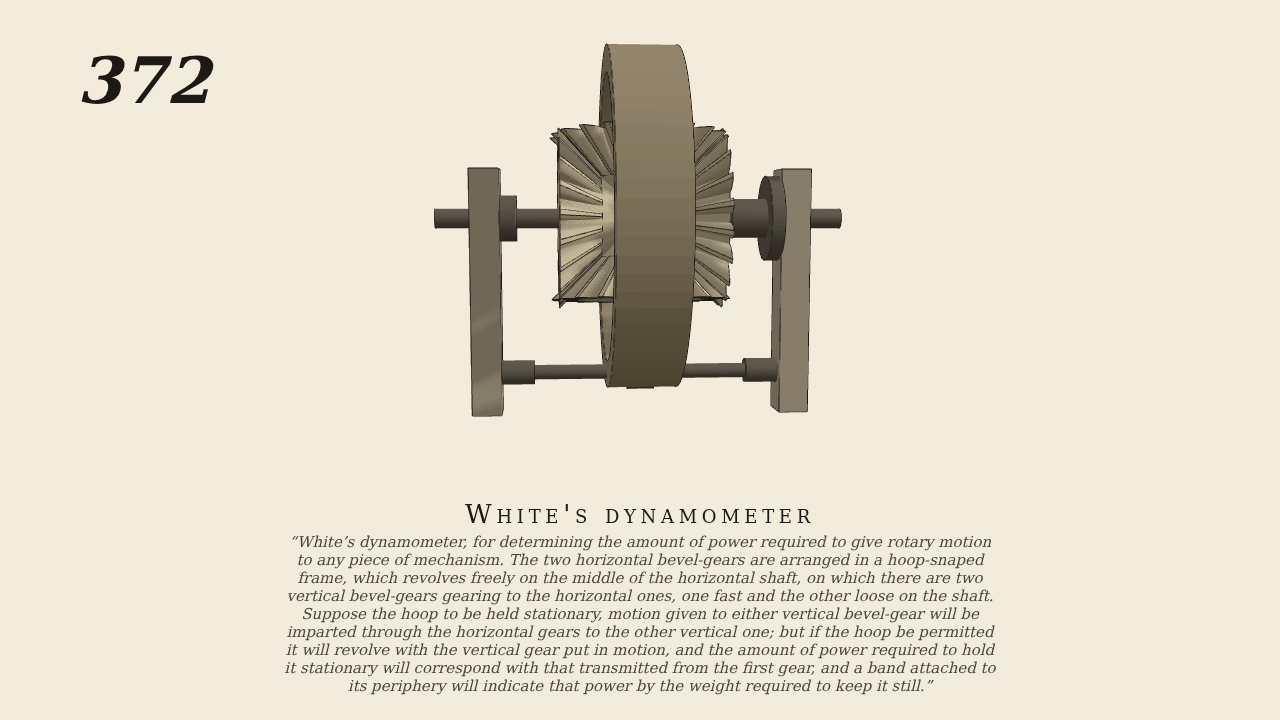
White’s dynamometer, for determining the amount of power required…
White’s dynamometer, for determining the amount of power required to give rotary motion to any piece of mechanism. The two horizontal bevel-gears are arranged in a hoop-snaped frame, which revolves freely on the middle of the horizontal shaft, on which there are two vertical bevel-gears gearing to the horizontal ones, one fast and the other loose on the shaft. Suppose the hoop to be held stationary, motion given to either vertical bevel-gear will be imparted through the horizontal gears to the other vertical one; but if the hoop be permitted it will revolve with the vertical gear put in motion, and the amount of power required to hold it stationary will correspond with that transmitted from the first gear, and a band attached to its periphery will indicate that power by the weight required to keep it still.
Only the input is driven; every other part of this model moves by physics (MuJoCo), and its ratios are measured. Run it live, change its parameters, or switch the friction off to see the output stop.
- Modelled as
- The horizontal shaft runs in two posts and is the only driven part, at 30 rev/min. Two vertical bevel-gears, 20 teeth and 5 cm pitch radius, face each other on it: the right one fast on the shaft, the left one loose, driving the load. The hoop hangs on the shaft between them and carries the two horizontal bevel-gears on pins, one above the shaft and one below, both in gear with both vertical ones. The load on the loose gear is 0.05 N m per rad/s. A torsional spring of 3 N m/rad on the hoop stands for the band and weight that keep it still.
- Measured
- With the hoop held, the loose gear turns back at the shaft's speed (measured -1.000). The hoop is carried round 0.105 rad (6.0 degrees) and rests there against its band. That is twice the load's torque (2 x 0.05 x 3.14 = 0.31 N m) over the band's 3 N m/rad, so the hoop's angle measures the power passed through the gears. Contact penetration stays under 0.1 mm.
- Notes
- Brown gives no sizes. The spring stands for the band and weight on the hoop's periphery: a weight alone could not hold the hoop at rest. Brown's load is any piece of mechanism; it is modelled as a damping on the loose gear.
Film (MP4) · Still (PNG) · Spec (YAML) · Model (MJCF)