Modification of mangle-wheel motion
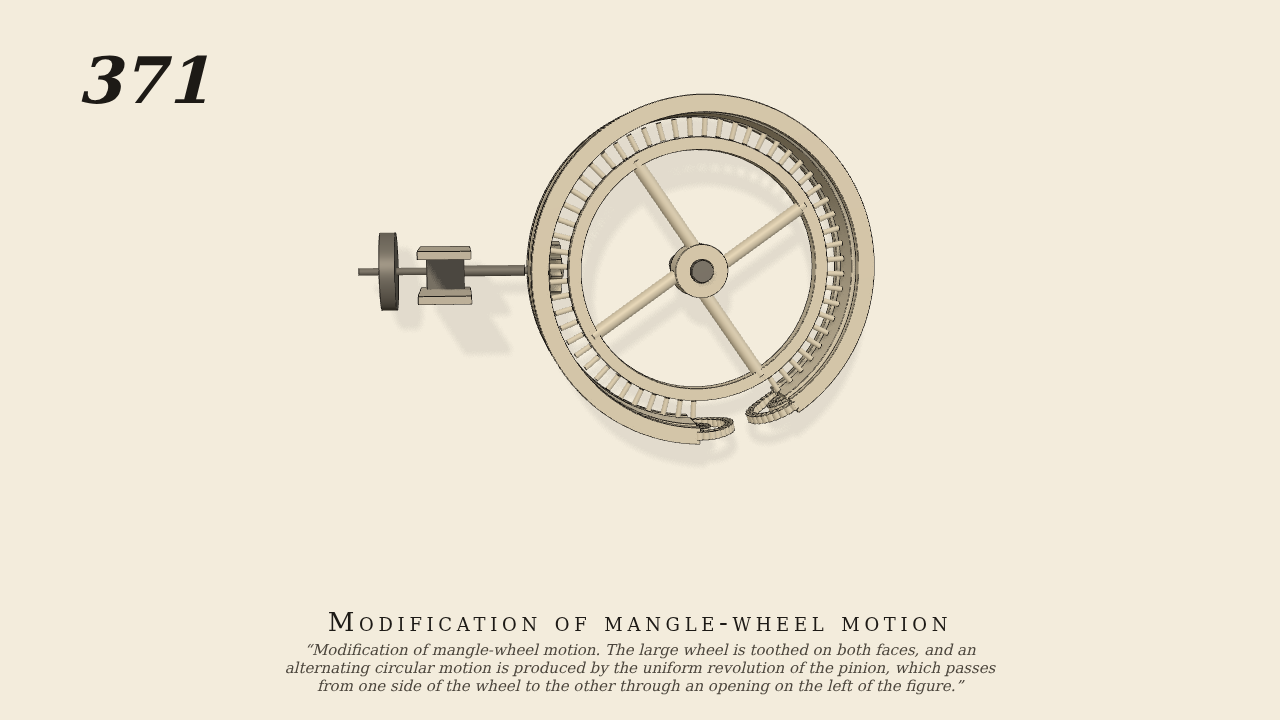
Modification of mangle-wheel motion. The large wheel is toothed on both faces, and an alternating circular motion is produced by the uniform revolution of the pinion, which passes from one side of the wheel to the other through an opening on the left of the figure.
Only the input is driven; every other part of this model moves by physics (MuJoCo), and its ratios are measured. Run it live, change its parameters, or switch the friction off to see the output stop.
- Modelled as
- The large wheel turns on a horizontal shaft. Its rim carries 55 radial teeth (round bars, one every 6 degrees on a 12 cm radius) standing clear of both faces, with an opening of 36 degrees at the lower left. The pinion, of 10 teeth and 2 cm pitch radius, is on a radial shaft at the left, the only driven part, at 60 rev/min. Its shaft runs in a carriage that slides along the wheel's axis. A follower on the carriage runs in a groove round the rim's outer face: two tracks, one before the teeth and one behind, joined by half-rounds about the two end teeth.
- Measured
- The pinion works on the front of the teeth and turns the wheel one way at 1/6 of its speed (measured 0.1667). At the opening the groove carries it 4 cm across, round the end tooth, to the back of the teeth, and the wheel then turns the other way at the same rate (measured -0.166). At the other end of the teeth it crosses back again. Contact penetration stays under 0.1 mm.
- Notes
- Brown gives no sizes. The teeth are round bars, thin enough (4.4 mm) to seat fully in the pinion's tooth spaces as it rounds the end teeth. The pinion's driving pulley adds the inertia that keeps the drive steady. Friction on the wheel's shaft holds it against the slight unbalance of the opening.
Film (MP4) · Still (PNG) · Spec (YAML) · Model (MJCF)