Motion for polishing mirrors, the rubbing of which should be…
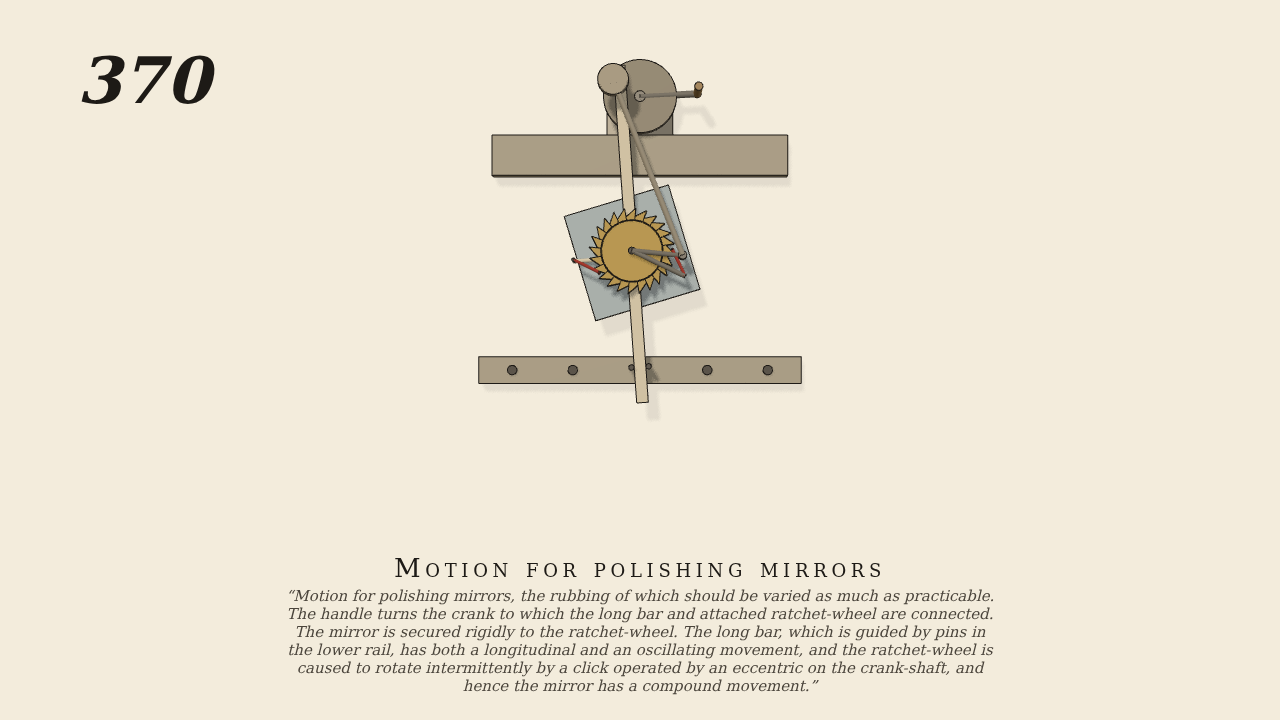
Motion for polishing mirrors, the rubbing of which should be varied as much as practicable. The handle turns the crank to which the long bar and attached ratchet-wheel are connected. The mirror is secured rigidly to the ratchet-wheel. The long bar, which is guided by pins in the lower rail, has both a longitudinal and an oscillating movement, and the ratchet-wheel is caused to rotate intermittently by a click operated by an eccentric on the crank-shaft, and hence the mirror has a compound movement.
Only the input is driven; every other part of this model moves by physics (MuJoCo), and its ratios are measured. Run it live, change its parameters, or switch the friction off to see the output stop.
- Modelled as
- The handle turns a crank of 4 cm on the upper rail, the only driven part, at 15 rev/min. The long bar hangs from the crank-pin and passes between two guide pins in the lower rail, 40 cm below the shaft; the pins rock with it, so the bar both slides endwise and swings. The ratchet-wheel, of 24 teeth, turns on an axle in the bar 26 cm below the crank-pin, with the square mirror fast to it. An eccentric on the crank-shaft, set 26 degrees ahead of the pin, works a rod down to the click lever, which rocks on the wheel's axle and carries a sprung click; a sprung detent on the bar keeps the wheel from running back.
- Measured
- Each turn of the crank swings the bar 0.100 rad either way about the guide pins (theory asin(4/40) = 0.100), slides it 8 cm endwise, and steps the wheel and mirror round one tooth: 0.0417 turns of the wheel per turn of the crank (theory 1/24 = 0.0417), with the wheel never running back more than 0.035 rad. So the mirror's motion is compounded of the sweep, the swing and a slow intermittent turn. Contact penetration stays under 0.4 mm.
- Notes
- Brown gives no sizes. The machine lies flat on the polishing bed, so it runs without gravity. The springs on the click and detent stand for the click springs in Brown's figure, which he does not show.
Film (MP4) · Still (PNG) · Spec (YAML) · Model (MJCF)