Cycloidal surfaces, causing pendulum to move in cycloidal curve,…
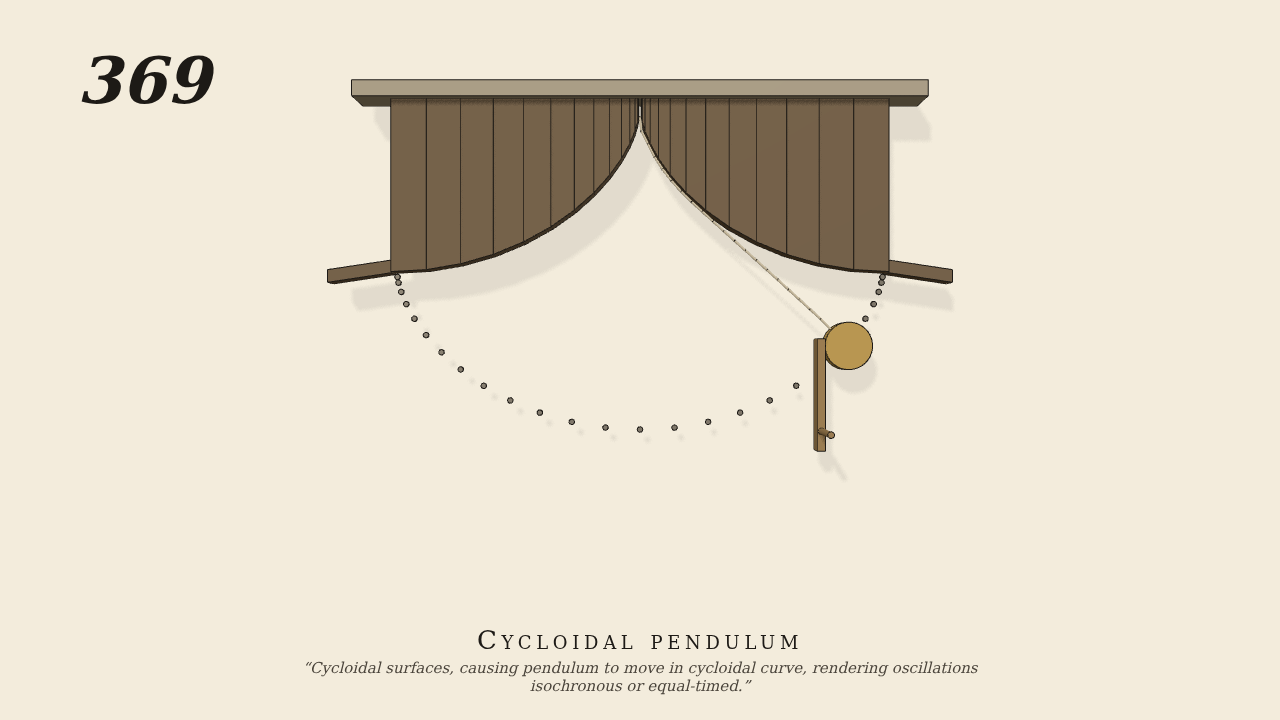
Cycloidal surfaces, causing pendulum to move in cycloidal curve, rendering oscillations isochronous or equal-timed.
Only the input is driven; every other part of this model moves by physics (MuJoCo), and its ratios are measured. Run it live, change its parameters, or switch the friction off to see the output stop.
- Modelled as
- The pendulum's cord, 37 cm long to a brass bob 6 cm across (40 cm to its centre), hangs from the cusp between two cheeks, each a half-arch of the cycloid generated by a circle of 10 cm radius (a = 10 cm, cord to the bob's centre = 4a). The cord is 20 short links hinged end to end, so it wraps on a cheek as it swings, and the bob goes along the cycloid instead of a circular arc. The operator's hand (a joint spring whose set point is moved, the only input) pushes the bob out with a pad, step by step, to 24 cm aside, and at 3 s draws the pad away; after that nothing acts but gravity.
- Measured
- Let go from 24 cm aside, the pendulum swings in 1.2652 s (over 5 swings, 3.5 to 12 s), the cycloid's 2 pi sqrt(4a/g) = 1.2687 s within 0.3%, the swing as wide at the end as at the start; the cord wraps on each cheek in turn and leaves the cusp at no more than 0.105 rad. Contact penetration stays under 0.2 mm.
- Notes
- Brown gives no sizes. The cord is a chain of 20 hinged links; the bob is let go once by the hand and swings freely. The dotted line behind the bob is its cycloidal path, drawn as in Brown's figure; it is not a part.
Film (MP4) · Still (PNG) · Spec (YAML) · Model (MJCF)