A parallel ruler with which lines may be drawn at required…
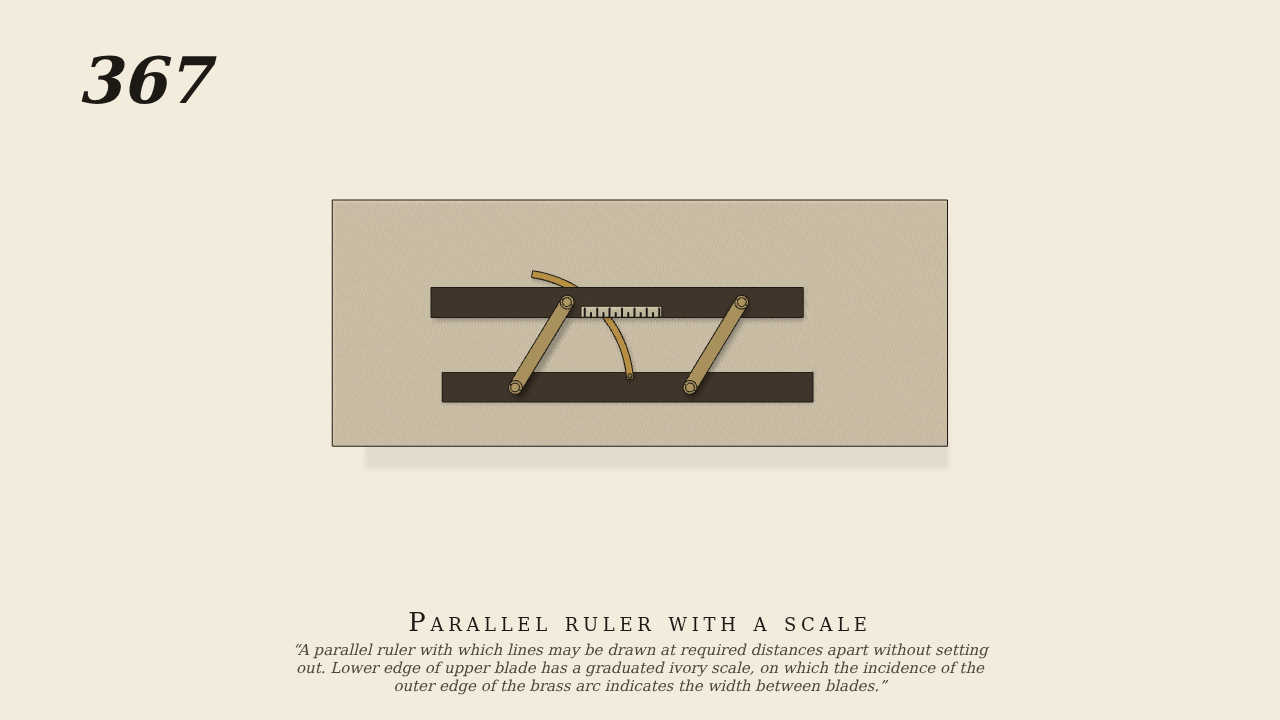
A parallel ruler with which lines may be drawn at required distances apart without setting out. Lower edge of upper blade has a graduated ivory scale, on which the incidence of the outer edge of the brass arc indicates the width between blades.
Only the input is driven; every other part of this model moves by physics (MuJoCo), and its ratios are measured. Run it live, change its parameters, or switch the friction off to see the output stop.
- Modelled as
- The lower blade lies still on the paper. Two equal links, 8 cm between centres, are pivoted on its centre-line 14 cm apart and carry the upper blade at their other ends, the far one by a pin, so blades and links make a parallelogram. The near link is the only driven part: the hand rocks it 0.4 rad each way about 60 degrees, five seconds to and fro. A brass arc, struck from the near link's lower pivot, is screwed to the lower blade, and the upper blade's lower edge carries an ivory scale; where the arc's outer edge comes out from under that edge, the scale reads the width between the blades.
- Measured
- The far link turns exactly with the near one (slope 1.0000, r² 1.0000) and the upper blade turns -1.0000 times the near link on it, so it stays parallel to the lower blade throughout, while the gap between the blades opens from 2.4 to 5.5 cm and closes again.
- Notes
- Brown gives no sizes. The scale is drawn as plain ticks; its figures are not engraved.
Film (MP4) · Still (PNG) · Spec (YAML) · Model (MJCF)