Drilling machine
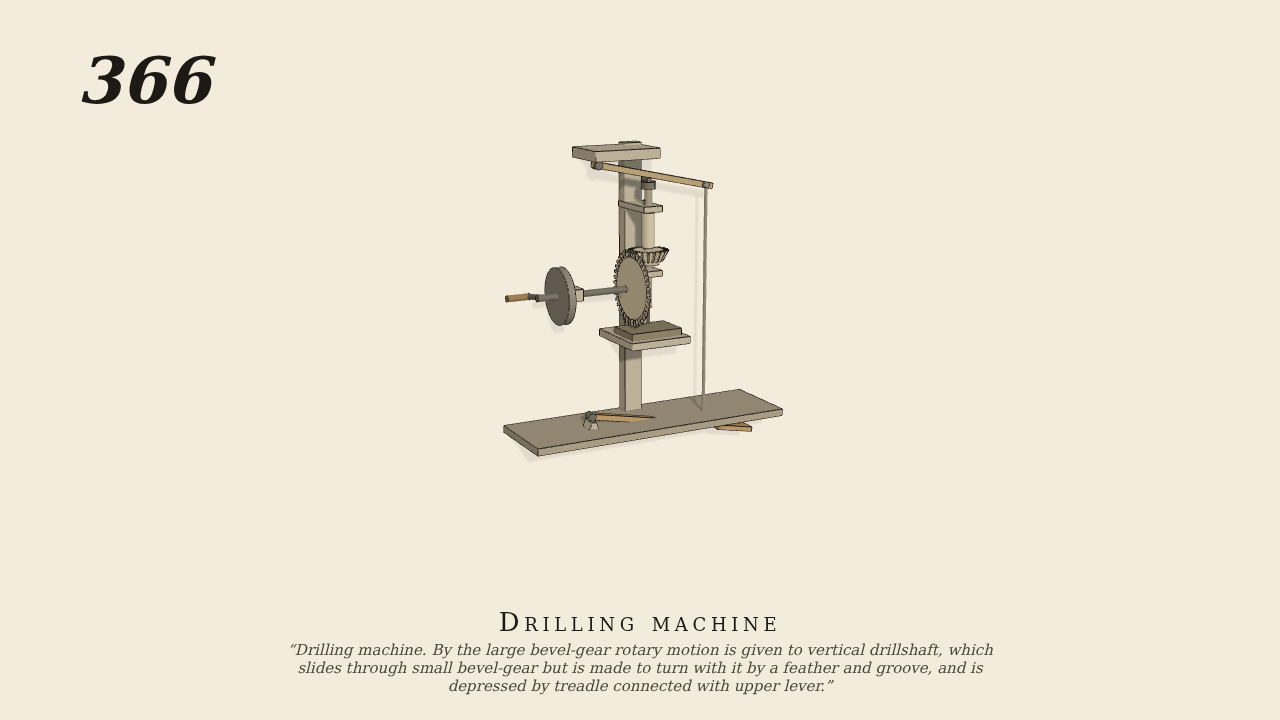
Drilling machine. By the large bevel-gear rotary motion is given to vertical drillshaft, which slides through small bevel-gear but is made to turn with it by a feather and groove, and is depressed by treadle connected with upper lever.
Only the input is driven; every other part of this model moves by physics (MuJoCo), and its ratios are measured. Run it live, change its parameters, or switch the friction off to see the output stop.
- Modelled as
- The crank shaft and the large bevel-gear, 40 teeth, are driven at 30 rev/min, the only driven part. The gear works a small bevel-gear of 20 teeth on a vertical sleeve in a bearing. The drill-shaft slides through the sleeve; a feather in the sleeve runs in a groove between ribs on the shaft, so it must turn with the sleeve while free to slide. A spring under the shaft's collar holds it up. An upper lever bears on the collar and is linked down to a treadle. From 2.5 s to 6 s the operator's foot presses the treadle down (a spring set point, released after), and the lever forces the shaft down until the bit meets the work on the table.
- Measured
- The drill-shaft turns at 2.000 times the crank throughout (theory: 40/20 = 2), and at 1.9995 times while pressed down and drilling, slip under 0.1%. It hangs at 0.95 cm below the top of its travel before the treadle is pressed, goes down to 2.60 cm with the bit on the work while pressed, and comes back to 0.77 cm after release. Contact penetration stays under 0.02 mm.
- Notes
- Brown gives no sizes. The treadle is pressed by a hand-set spring point standing for the foot, and the work is a fixed block on the table.
Film (MP4) · Still (PNG) · Spec (YAML) · Model (MJCF)