Cylindrical rod arranged between two rollers, the axes of which…
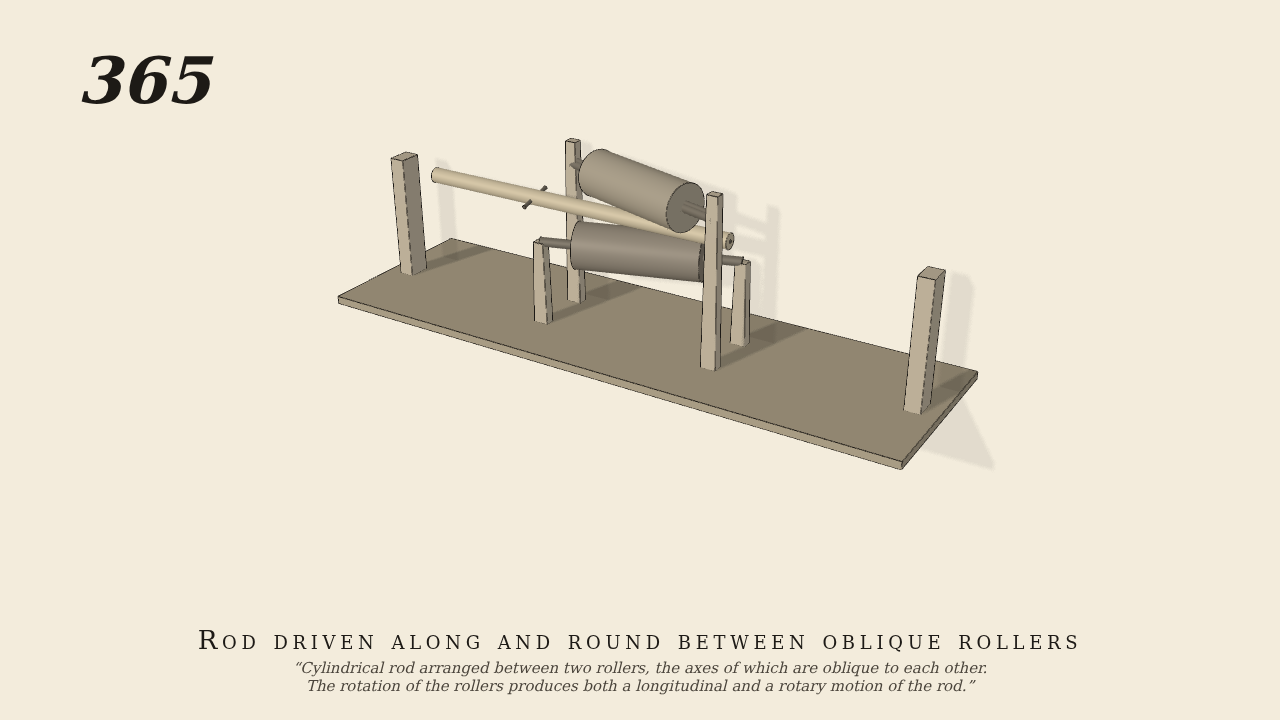
Cylindrical rod arranged between two rollers, the axes of which are oblique to each other. The rotation of the rollers produces both a longitudinal and a rotary motion of the rod.
Only the input is driven; every other part of this model moves by physics (MuJoCo), and its ratios are measured. Run it live, change its parameters, or switch the friction off to see the output stop.
- Modelled as
- The lower roller, 6 cm across, is driven at 10 rev/min, the only driven part. The rod, 2 cm across, lies on it, held in end guides so that it can slide along and turn about its own axis (and rise and fall a little). The upper roller, the same size and free, rests on the rod by its weight in a vertical guide. Each roller's axis leans 0.3 rad from the rod's, the two opposite ways, so that their axes are oblique to each other.
- Measured
- The rod goes along 0.0089 m for each radian of the driver (theory: roller radius × sin 0.3 = 0.00887) and turns the other way 2.867 times as fast as the roller (theory: 3 × cos 0.3 = 2.866), both within 0.4% over 1 to 7 s, the upper roller rolling with it. Contact penetration stays under 0.01 mm.
- Notes
- Brown gives no sizes or angles. The rod is held to its line by end guides, and the upper roller is pressed by its own weight.
Film (MP4) · Still (PNG) · Spec (YAML) · Model (MJCF)