Intermittent rotary motion from continuous rotary motion about an…
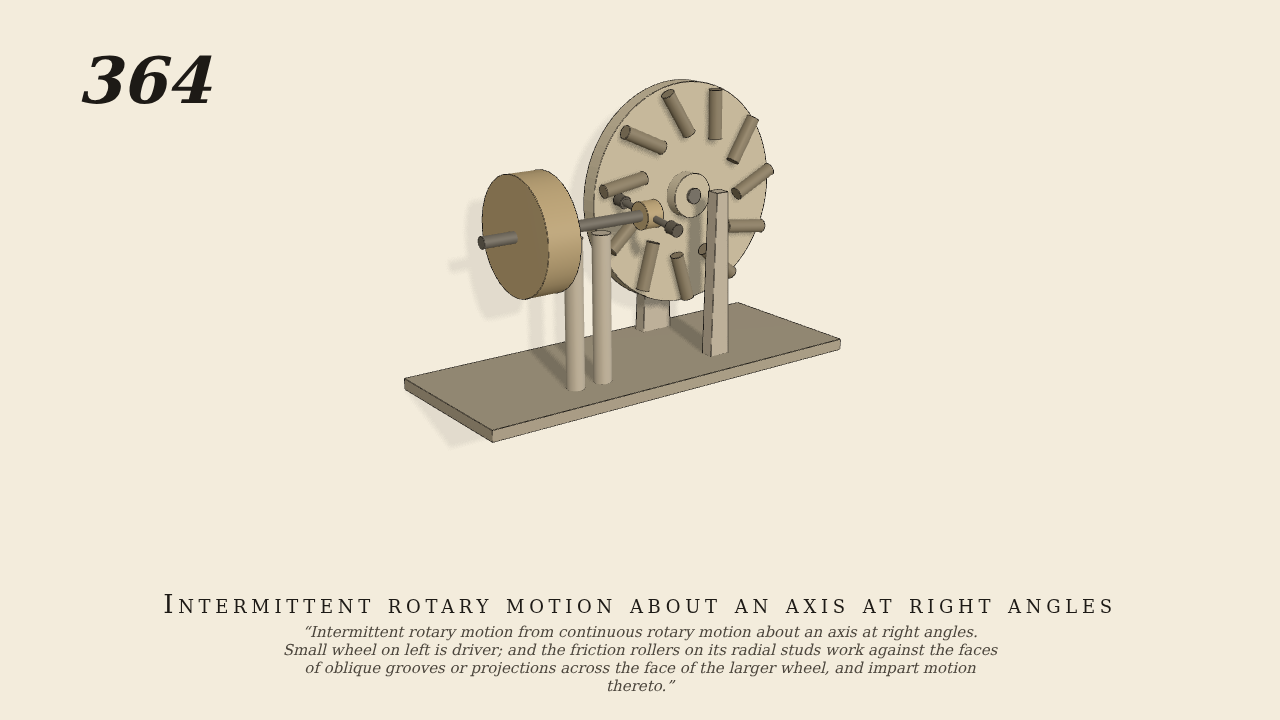
Intermittent rotary motion from continuous rotary motion about an axis at right angles. Small wheel on left is driver; and the friction rollers on its radial studs work against the faces of oblique grooves or projections across the face of the larger wheel, and impart motion thereto.
Only the input is driven; every other part of this model moves by physics (MuJoCo), and its ratios are measured. Run it live, change its parameters, or switch the friction off to see the output stop.
- Modelled as
- The small wheel on the left is driven at 20 rev/min, the only driven part; its shaft lies across the face of the larger wheel, at right angles to that wheel's axis. It carries two radial studs, each with a roller on its end. The larger wheel, 20 cm across, has 11 ribs standing out from its face, each leaning 0.24 rad across the radius (the oblique projections); it turns against a little friction and damping. Each roller, as its stud comes round towards the face, sweeps past the wheel's left side and catches a rib.
- Measured
- Each roller in turn pushes a rib on through about a quarter of the stud's turn, carrying the larger wheel on one step of 1/11 turn (0.57 rad), and the wheel then stands until the next roller comes round. Over two turns of the driver from 3.2 s the larger wheel goes 0.1831 times as fast, against 2/11 = 0.1818; its speed through the turn runs from standing (0.000) to 0.52 of the driver's. Contact penetration stays under 0.05 mm.
- Notes
- Brown gives no sizes or numbers of studs and ribs. The rollers are drawn on the studs but do not spin; they bear on the ribs with little friction instead. The first step is longer than the rest, as the wheel is thrown on from rest.
Film (MP4) · Still (PNG) · Spec (YAML) · Model (MJCF)