Continuous rotary motion from oscillating
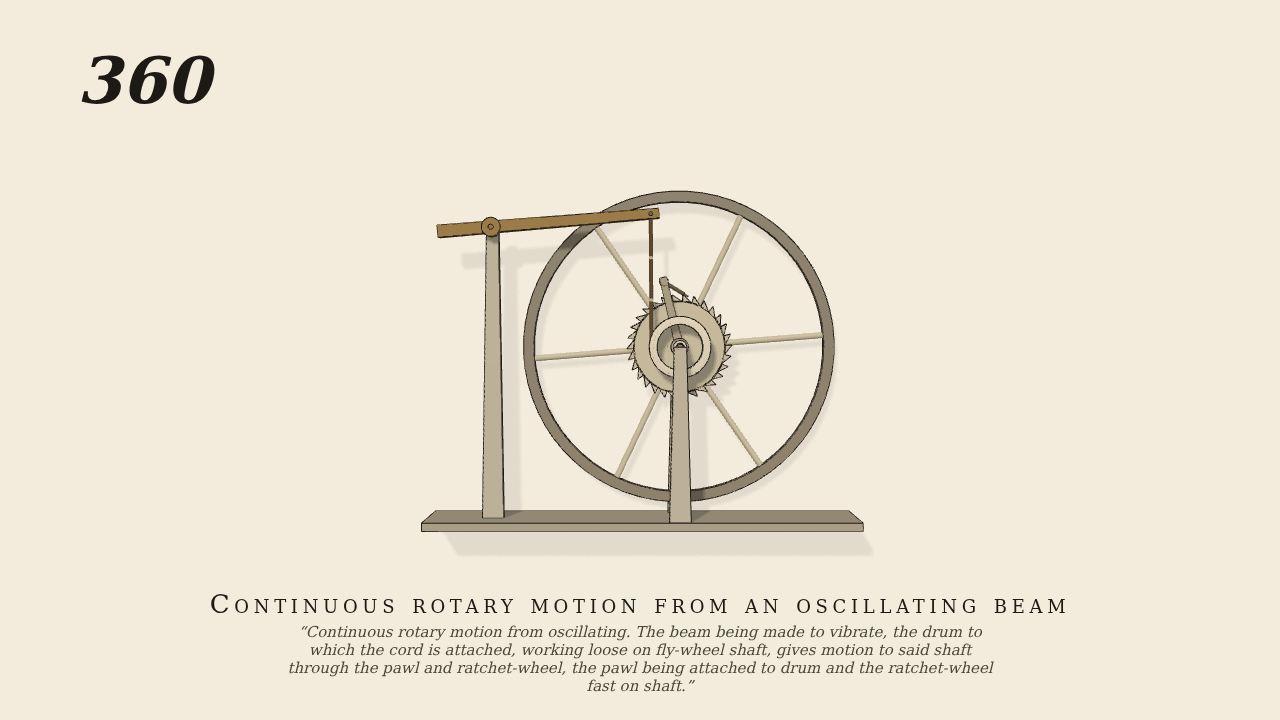
Continuous rotary motion from oscillating. The beam being made to vibrate, the drum to which the cord is attached, working loose on fly-wheel shaft, gives motion to said shaft through the pawl and ratchet-wheel, the pawl being attached to drum and the ratchet-wheel fast on shaft.
Only the input is driven; every other part of this model moves by physics (MuJoCo), and its ratios are measured. Run it live, change its parameters, or switch the friction off to see the output stop.
- Modelled as
- The beam, pivoted 24 cm from its end, is rocked 0.085 rad each way at half a stroke a second; this is the only driven part. A cord from its end comes down the left side of the drum (4 cm across the rim), under it, and is made fast to it. The drum turns loose on the fly-wheel shaft, and a spring in it (0.5 N·m per radian, already winding 0.6 N·m) winds the cord back as the beam comes down. An arm on the drum carries the pawl, which a light spring keeps to the teeth of the 30-tooth ratchet-wheel fast on the shaft. The fly-wheel, an iron ring 26 cm across of about 4 kg, is on the same shaft, which turns against a little friction and damping.
- Measured
- As the beam rises the drum turns clockwise about 0.73 rad and the pawl drives the ratchet-wheel; as it falls the drum winds back and the pawl rides over the teeth while the fly-wheel carries the shaft on. From 4 s the shaft turns at 0.82 rad/s on average (7.8 rev/min), faster than half that 93% of the time, and it never turns back. Contact penetration stays under 0.6 mm.
- Notes
- Brown gives no sizes and does not say what winds the cord back; a spring in the drum is used. The first pull throws the fly-wheel faster than the drum can follow, so it coasts a stroke or so before the pawl takes hold again.
Film (MP4) · Still (PNG) · Spec (YAML) · Model (MJCF)