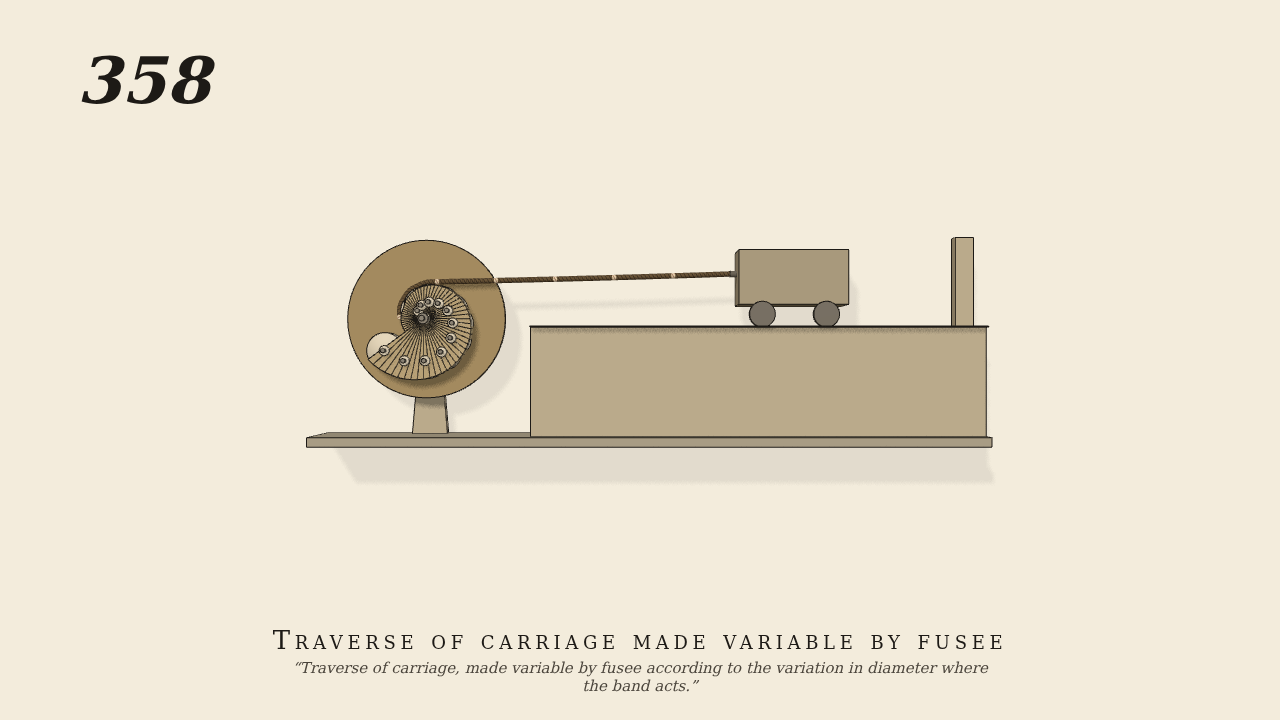
Traverse of carriage, made variable by fusee according to the…
Traverse of carriage, made variable by fusee according to the variation in diameter where the band acts.
Only the input is driven; every other part of this model moves by physics (MuJoCo), and its ratios are measured. Run it live, change its parameters, or switch the friction off to see the output stop.
- Modelled as
- The fusee is made here as a flat volute: in one plane, its edge runs out from 2.5 cm from the shaft to 7.65 cm over most of a turn. It is turned at an even 6 rev/min, the one driven part. A band 6 mm thick is tied to the volute's small end and runs straight to the carriage, which stands on a rail 40 cm off. A spring on the carriage's slide (20 N/m, already pulling 8 N) draws the carriage away from the fusee and keeps the band tight. The band bears on the volute through eleven round rims set round it, each touching the volute's edge, so it lies on their outline.
- Measured
- As the band winds on, it acts further and further from the shaft, and the carriage goes faster. Over 0.5 to 7.8 s the carriage moves 3.1 cm per radian of the fusee at first and 6.8 cm per radian at the end (slices of the run), against 2.8 and 6.9 cm for the volute's radius plus half the band. In 8 s the fusee turns 4.9 radians and the carriage comes 22 cm. Contact penetration stays under 0.15 mm.
- Notes
- Brown gives no sizes. A true fusee is a cone with a spiral groove, the band laid along it; in this model a band can only lie in one plane, so the fusee is drawn flat, as a volute, which varies the radius the same way. The volute's edge between the rims is drawn but the band rests on the rims.
Film (MP4) · Still (PNG) · Spec (YAML) · Model (MJCF)