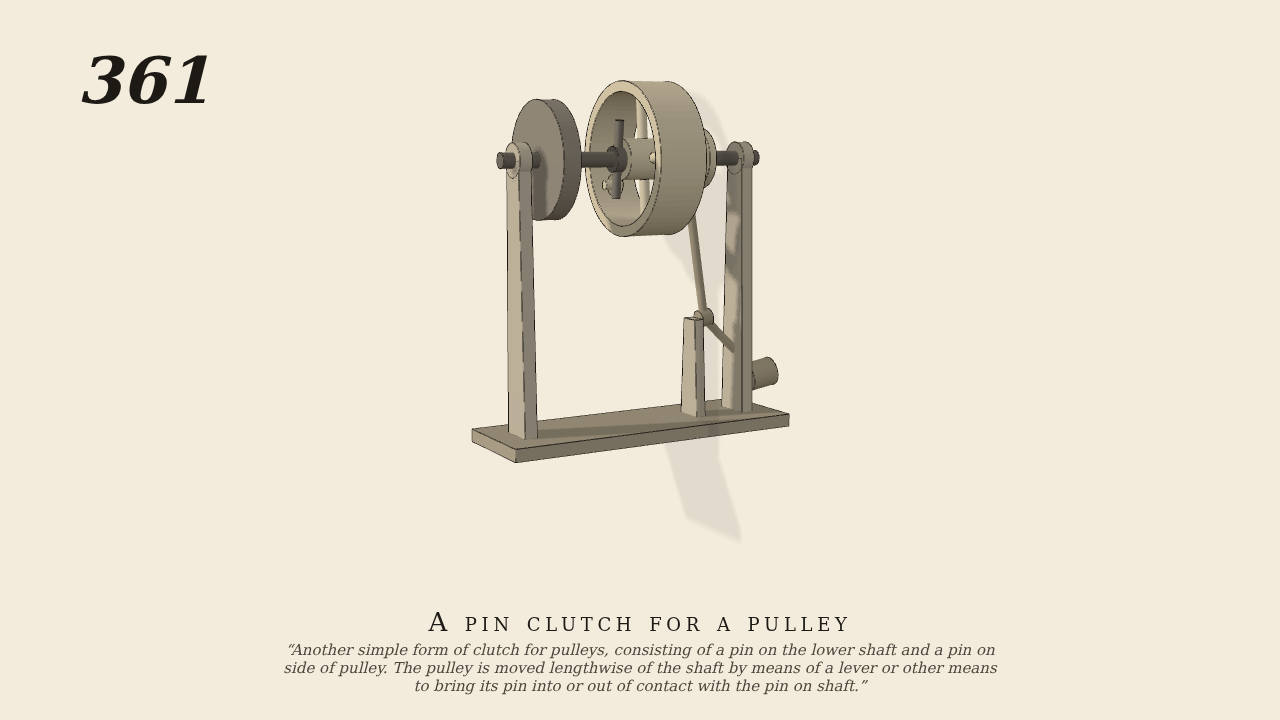
Another simple form of clutch for pulleys, consisting of a pin on…
Another simple form of clutch for pulleys, consisting of a pin on the lower shaft and a pin on side of pulley. The pulley is moved lengthwise of the shaft by means of a lever or other means to bring its pin into or out of contact with the pin on shaft.
Only the input is driven; every other part of this model moves by physics (MuJoCo), and its ratios are measured. Run it live, change its parameters, or switch the friction off to see the output stop.
- Modelled as
- The lower shaft is driven at 30 rev/min, the only driven part. A pin 7 mm thick goes through it, standing out 3 cm each side. The pulley, 12 cm across, turns loose on a sleeve that slides along the shaft without turning; a pin on the side of the pulley, 2.2 cm from the centre, points at the shaft's pin. The pulley's load is a little damping, for its belt. The prong of the lever's fork stands in a groove in the pulley's hub; a spring holds the lever where the hand puts it: pressed in at 2 s and drawn back at 5.5 s.
- Measured
- Out of gear the pulley stands (0.0000 of the shaft's speed over 0.5 to 1.9 s); the shaft's pin passes 3 mm clear of the pulley's pin. Pressed in, the pulley slides 1.7 cm along the shaft, the shaft's pin comes round to the pulley's pin within a turn and carries it: 1.0000 of the shaft's speed over 3.5 to 5.3 s. Drawn back, the pins part and the pulley stops (0.0000 over 6.5 to 7.9 s). Contact penetration stays under 0.12 mm.
- Notes
- Brown gives no sizes. The pulley's belt is left out; its load is the damping on the pulley's bearing. The pulley's pin hangs at the bottom when out of gear, so that its weight does not turn the pulley.
Film (MP4) · Still (PNG) · Spec (YAML) · Model (MJCF)