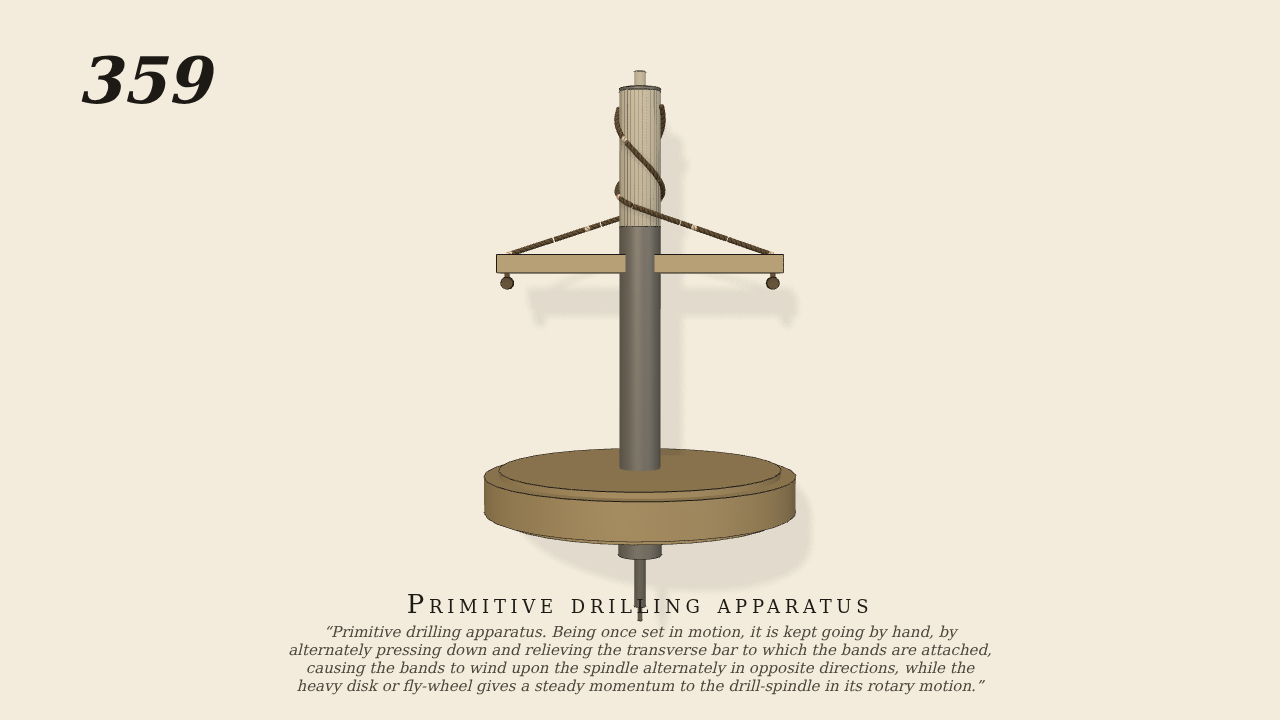
Primitive drilling apparatus
Primitive drilling apparatus. Being once set in motion, it is kept going by hand, by alternately pressing down and relieving the transverse bar to which the bands are attached, causing the bands to wind upon the spindle alternately in opposite directions, while the heavy disk or fly-wheel gives a steady momentum to the drill-spindle in its rotary motion.
Only the input is driven; every other part of this model moves by physics (MuJoCo), and its ratios are measured. Run it live, change its parameters, or switch the friction off to see the output stop.
- Modelled as
- The spindle, 2.8 cm across, turns on its point about the vertical and carries the heavy disk (21 cm across, about 1.8 kg), the chuck and the bit; the bit's cut is a little damping on it. The transverse bar, 19 cm long, slides on the spindle and is held by the hand so it does not turn. Two bands, made fast at opposite sides of the spindle's top, are 3D open cords lying wound round it and run down to the bar's ends. The one driven input is the hand: it presses the bar down with up to 8 N for half of each 2.5 s stroke and lets go for the other half (it can only push, never lift).
- Measured
- Each press unwinds the bands and spins the spindle; the disk's momentum carries it on, winds the bands on again the other way and lifts the bar for the next press, so the spindle turns alternately one way and the other, about 2.2 turns each way, with a period of 5 s (two presses). The bar rides between 9.7 cm below and 0.9 cm above its start, clear of its stops; the bands sink at most 0.75 mm into the spindle. With the bands let go of the spindle the hand still works the bar and the spindle stands (0.3% of its working speed).
- Notes
- Brown gives no sizes; the hand's press is a force that only pushes. The flywheel is lighter than "heavy" would suggest (1.8 kg), so it settles to a steady beat at 0.4 presses a second.
Film (MP4) · Still (PNG) · Spec (YAML) · Model (MJCF)