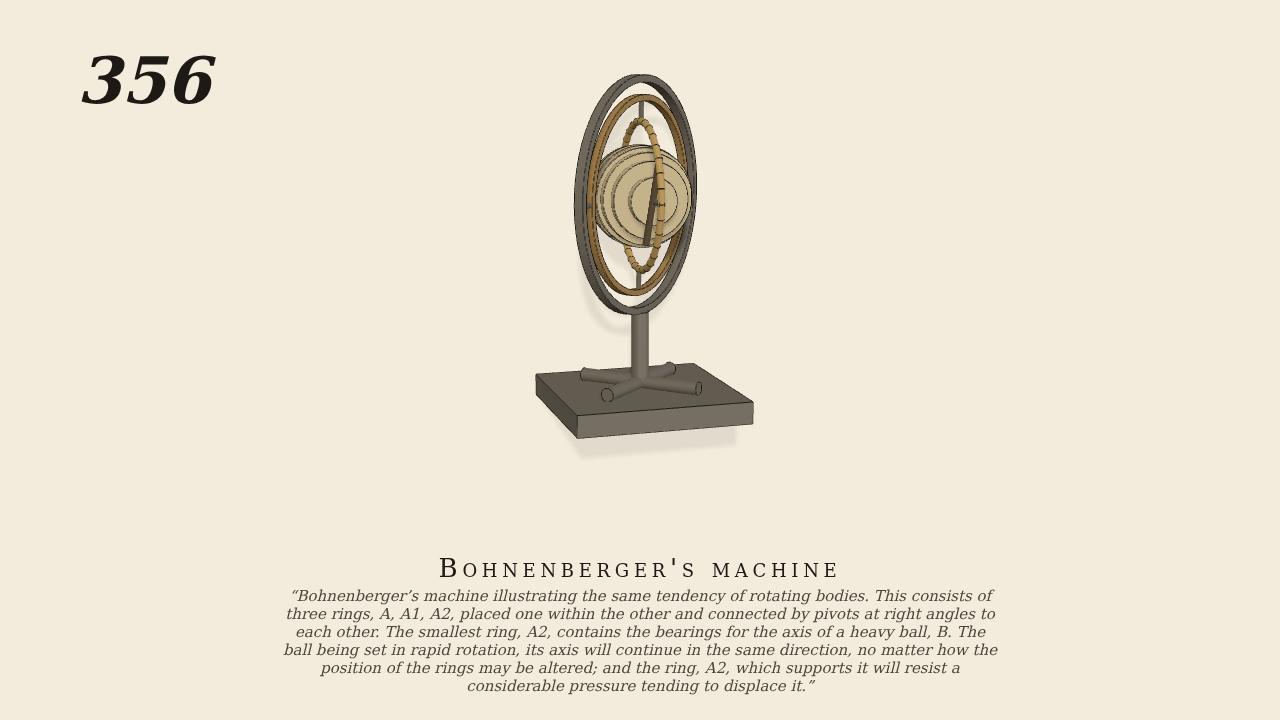
Bohnenberger’s machine illustrating the same tendency of rotating…
Bohnenberger’s machine illustrating the same tendency of rotating bodies. This consists of three rings, A, A1, A2, placed one within the other and connected by pivots at right angles to each other. The smallest ring, A2, contains the bearings for the axis of a heavy ball, B. The ball being set in rapid rotation, its axis will continue in the same direction, no matter how the position of the rings may be altered; and the ring, A2, which supports it will resist a considerable pressure tending to displace it.
Only the input is driven; every other part of this model moves by physics (MuJoCo), and its ratios are measured. Run it live, change its parameters, or switch the friction off to see the output stop.
- Modelled as
- Ring A, 20 cm across, stands on a pillar that the hand turns about the vertical. Ring A1 hangs inside A on pivots across it, and ring A2 hangs inside A1 on pivots up and down, at right angles to the first. A2 carries the bearings for the axis of the ball B, which is 9 cm across (about 3 kg of iron) and lies level, front to back. The pivots have a little friction (0.04 N·m). The ball is kept spinning at 4000 rev/min; this is the only driven part. The hand turns the stand through a spring, its grip: 45 degrees one way at 1 s, 45 degrees the other way at 3.5 s, and back to the start at 6 s.
- Measured
- While the stand and ring A turn, the ball's axis keeps its direction. Over 0.5 to 7.9 s, ring A2 turns back in A1 by 0.985 of the stand's turn (r² 0.9995). The ball's axis ends within 0.06 rad (3 degrees) of where it started, and A1 tilts in A by less than 0.02 rad. The pivot friction that tries to carry the ball round only makes the axis creep slowly.
- Notes
- Brown gives no sizes. The ball is spun by a drive in its bearings rather than set spinning and let go, because the model cannot start with a part already turning. Ring A2 does not stay square to the ball's axis when the stand turns far: at 90 degrees the ball's axis would lie along A1's pivots, the rings lose a freedom, and the axis flips. So the hand turns the stand 45 degrees each way. The ball is built from discs across its axis.
Film (MP4) · Still (PNG) · Spec (YAML) · Model (MJCF)