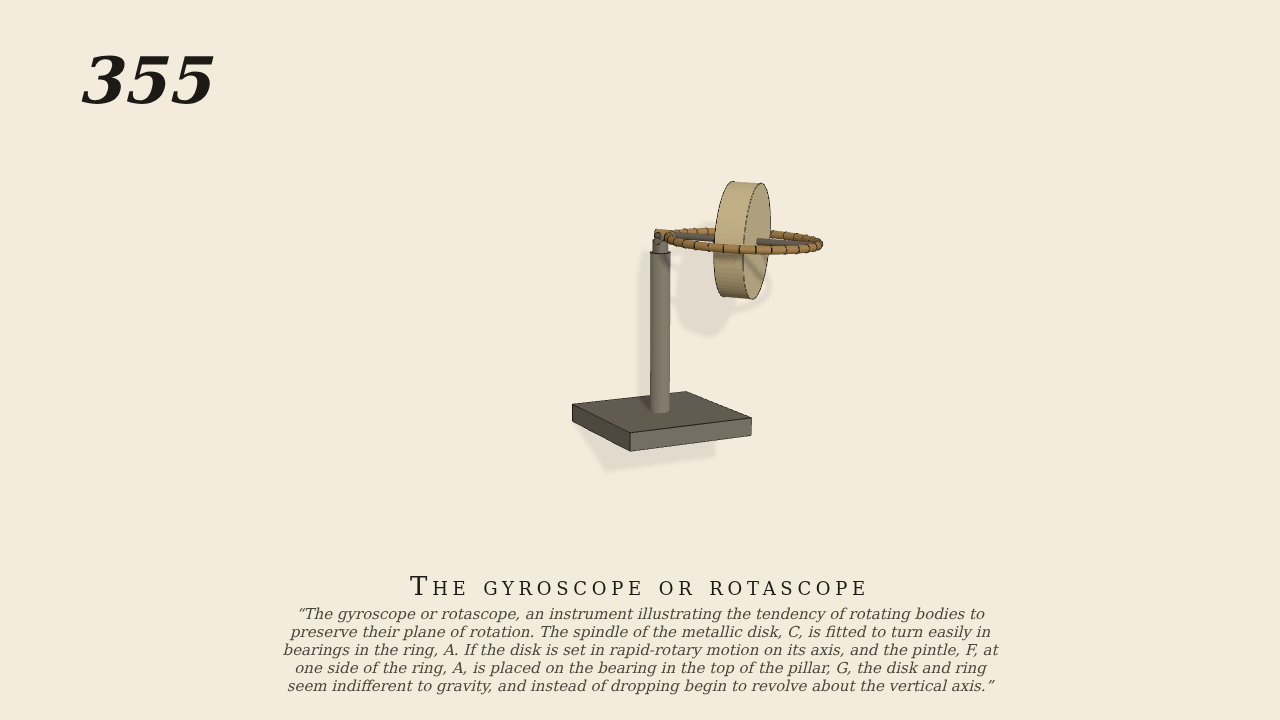
The gyroscope or rotascope, an instrument illustrating the…
The gyroscope or rotascope, an instrument illustrating the tendency of rotating bodies to preserve their plane of rotation. The spindle of the metallic disk, C, is fitted to turn easily in bearings in the ring, A. If the disk is set in rapid-rotary motion on its axis, and the pintle, F, at one side of the ring, A, is placed on the bearing in the top of the pillar, G, the disk and ring seem indifferent to gravity, and instead of dropping begin to revolve about the vertical axis.
Only the input is driven; every other part of this model moves by physics (MuJoCo), and its ratios are measured. Run it live, change its parameters, or switch the friction off to see the output stop.
- Modelled as
- The disk C is 10 cm across and 2.5 cm thick (1.57 kg of iron). It turns on a spindle in bearings in the ring A, which is 13 cm across. The pintle F stands out from the ring along the spindle's line, and rests in a cap on top of the pillar G. The cap turns freely about the pillar's axis, and the ring tilts freely on the cap: together they make a free pivot. The disk's centre is 7.5 cm out from the pivot. Nothing holds the ring up. The disk is kept spinning at 4000 rev/min; this is the only driven part. A stop 0.6 rad (34 degrees) below level stands for the edge of the pillar's cup.
- Measured
- The disk and ring do not drop. Over 1 to 7.5 s the ring tilts no more than 0.067 rad (4 degrees) and swings about the vertical at 1.54 rad/s, a turn in 4.1 s. The theory of the fast top gives 1.543 rad/s: the weight's moment about the pivot (1.24 N·m) divided by the disk's spin momentum (1.92e-3 kg·m² × 419 rad/s). Measured against the spin, the ratio is 0.00368 (0.08% from the theory). The swing goes against the clock seen from above, for a disk spinning clockwise seen from its outer end.
- Notes
- Brown gives no sizes. The disk is spun by a drive in its bearing rather than set spinning and let go, because the model cannot start with a part already turning. It is up to speed in about 0.04 s, and the small nod the ring makes then dies away into the steady swing. The free pivot on the pillar is two hinges, about the vertical and across the spindle, not a point resting in a cup.
Film (MP4) · Still (PNG) · Spec (YAML) · Model (MJCF)