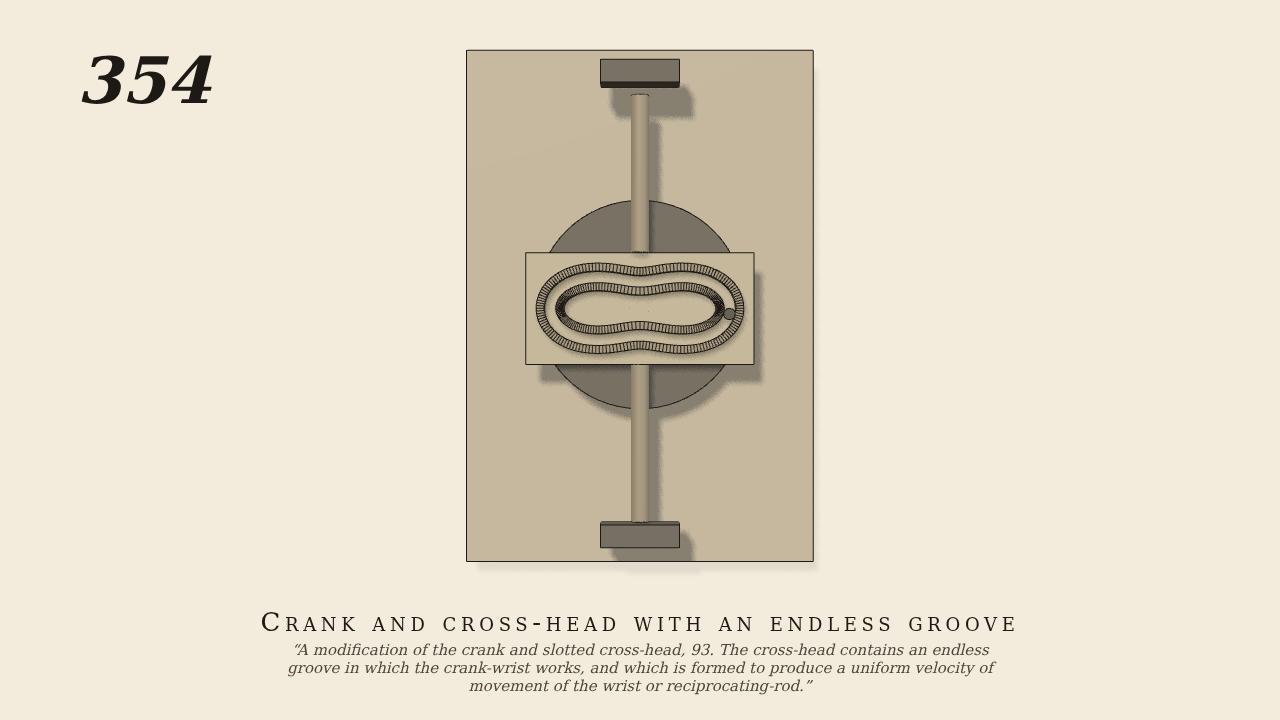
A modification of the crank and slotted cross-head, 93. The…
A modification of the crank and slotted cross-head, 93. The cross-head contains an endless groove in which the crank-wrist works, and which is formed to produce a uniform velocity of movement of the wrist or reciprocating-rod.
Only the input is driven; every other part of this model moves by physics (MuJoCo), and its ratios are measured. Run it live, change its parameters, or switch the friction off to see the output stop.
- Modelled as
- The crank is 8 cm long, and its wrist, 1 cm across, works in an endless groove 1.04 cm wide cut in the cross-head. The cross-head slides on a straight guide and carries the reciprocating rod. The groove is drawn as the path of the wrist seen from a cross-head that moves at an even speed: down 11.2 cm in one half turn and back up in the other. Its ends are rounded over the last few degrees of each stroke, so that the groove has no sharp corner to jam the wrist. The crank turns at 30 rev/min. It is the only driven part, and it moves the cross-head only by contact of the wrist on the groove's walls. The machine is shown as a horizontal engine seen from above, so there is no gravity.
- Measured
- Over the middle of each stroke (0.6 rad from either end) the rod moves 3.98 cm per radian of the crank going down and 3.99 cm per radian coming back, against 3.97 cm for the groove's design: an even speed of 12.5 cm/s, with r² 0.9997. A plain slotted cross-head (No. 93) moves the rod as the cosine of the crank angle, fastest at mid-stroke and stopping at each end. The stroke is 11.2 cm. The deepest contact is 0.012 mm.
- Notes
- Brown gives no sizes or groove shape. The groove here is worked out from the uniform motion he asks for. Standing upright, the cross-head's own weight would carry it past the groove's turning points at each side of the crank's sweep, where the groove guides it only sideways. So it is shown lying flat, like the cross-head of a horizontal engine.
Film (MP4) · Still (PNG) · Spec (YAML) · Model (MJCF)