A modification of the tilt or trip hammer, illustrated by 72. In…
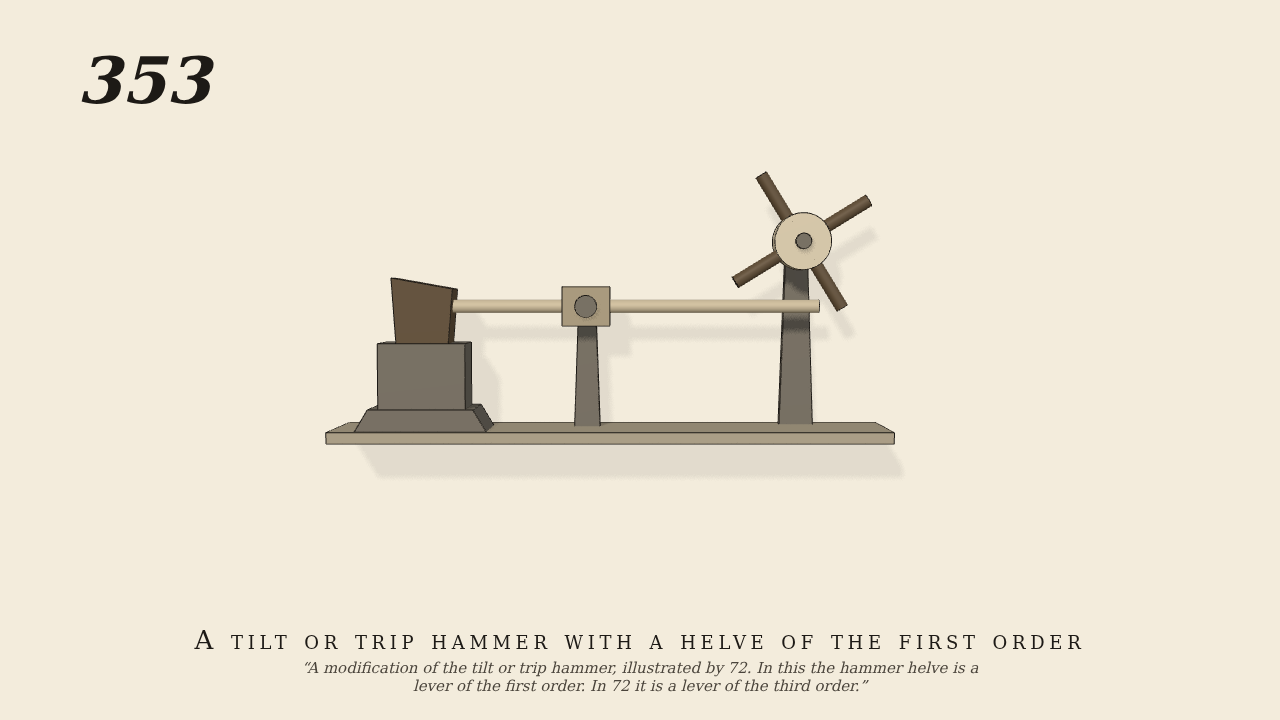
A modification of the tilt or trip hammer, illustrated by 72. In this the hammer helve is a lever of the first order. In 72 it is a lever of the third order.
Only the input is driven; every other part of this model moves by physics (MuJoCo), and its ratios are measured. Run it live, change its parameters, or switch the friction off to see the output stop.
- Modelled as
- The helve turns on a centre between its ends. The head A is 15 cm out on one side of the centre, and the tail is 21.6 cm out on the other. The wiper wheel stands beside the tail. Its four wipers reach 7.2 cm from its shaft, and the tail lies 6 cm below the shaft, reaching just past it. At rest the head lies on the anvil. The wheel turns against the clock at 12 rev/min. It is the only driven part. The wipers press the tail only by contact, and the hammer falls only by its own weight. A stop on the helve's centre stands for the anvil's bed when nothing else holds the head.
- Measured
- Each wiper comes down on the tail, presses it down 0.12 rad (7 degrees), and so raises the head 1.8 cm. Then it slips off the tail's end, and the hammer falls on the anvil. There are four blows to each turn of the wheel, a quarter turn between blows to within 1%, and 8 full lifts in 9.2 s. The deepest contact is 0.10 mm. In No. 72 the wipers lift the nose and the head lies between the nose and the centre: a lever of the third order. Here the centre lies between the head and the tail where the wipers press: a lever of the first order.
- Notes
- Brown gives no sizes. The wipers and the lift are No. 72's at twice the size, turned upside down at the tail. The head is raised less than in Brown's figure, which shows it near the top of its lift.
Film (MP4) · Still (PNG) · Spec (YAML) · Model (MJCF)