Stamp
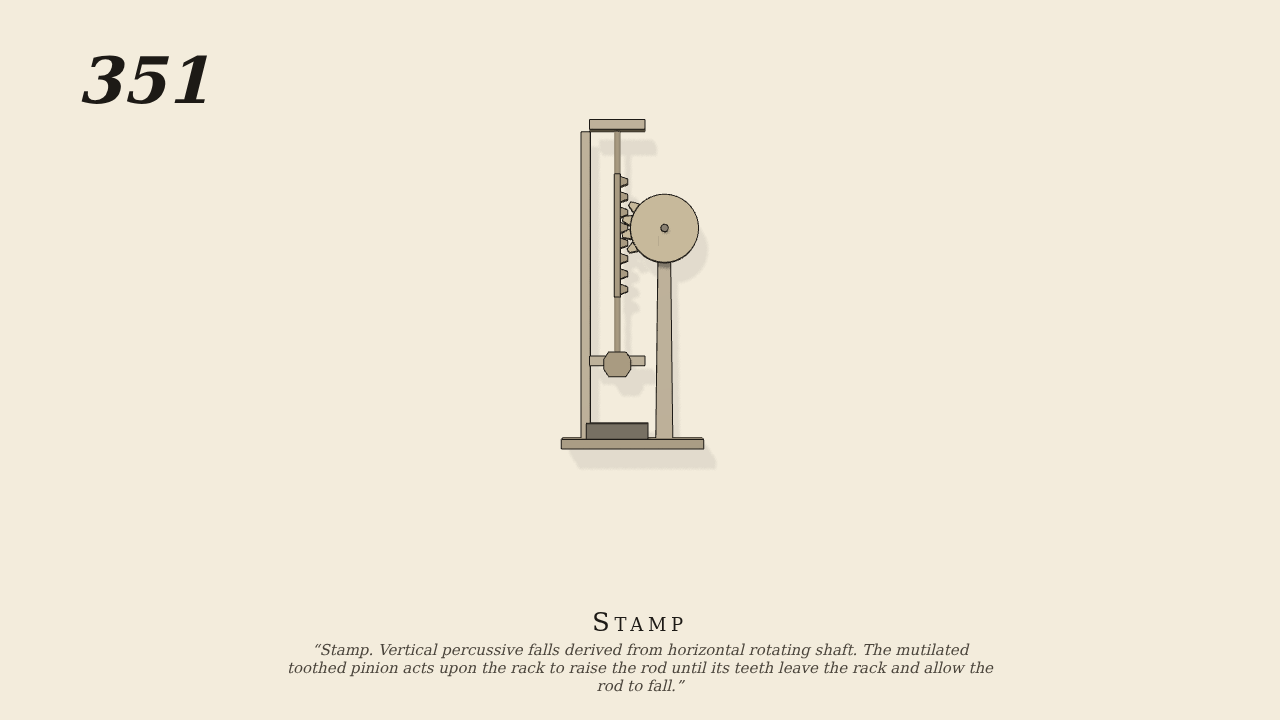
Stamp. Vertical percussive falls derived from horizontal rotating shaft. The mutilated toothed pinion acts upon the rack to raise the rod until its teeth leave the rack and allow the rod to fall.
Only the input is driven; every other part of this model moves by physics (MuJoCo), and its ratios are measured. Run it live, change its parameters, or switch the friction off to see the output stop.
- Modelled as
- The pinion A, 12.8 cm across at the pitch line, is on the horizontal shaft. It has teeth on 4 of its 16 tooth spaces and is cut down to its root circle round the rest. The teeth are No. 81's straight-flanked teeth, module 0.8. The stamp-rod slides upright in its guides. Its rack stands on its right side, facing the pinion, and its head rests on the die. The rod is held up only by the teeth meshing with the rack, and it falls by its own weight. The shaft is turned at 30 rev/min. It is the only driven part.
- Measured
- While A's teeth are in the rack, the rod rises as A's pitch line, 0.064 m to each radian, within 2%. After about 14 cm the last tooth leaves the rack and the rod falls on the die. There it lies until the first tooth comes round into the same rack space on the next turn, so there is one blow every 2 seconds. The blow presses deepest into the die, 1.2 mm. Elsewhere contact stays under 0.1 mm.
- Notes
- Brown gives no sizes. The rack teeth and pinion teeth are drawn after No. 81. The rod's guides are drawn as two cross-bars and the die as a block.
Film (MP4) · Still (PNG) · Spec (YAML) · Model (MJCF)