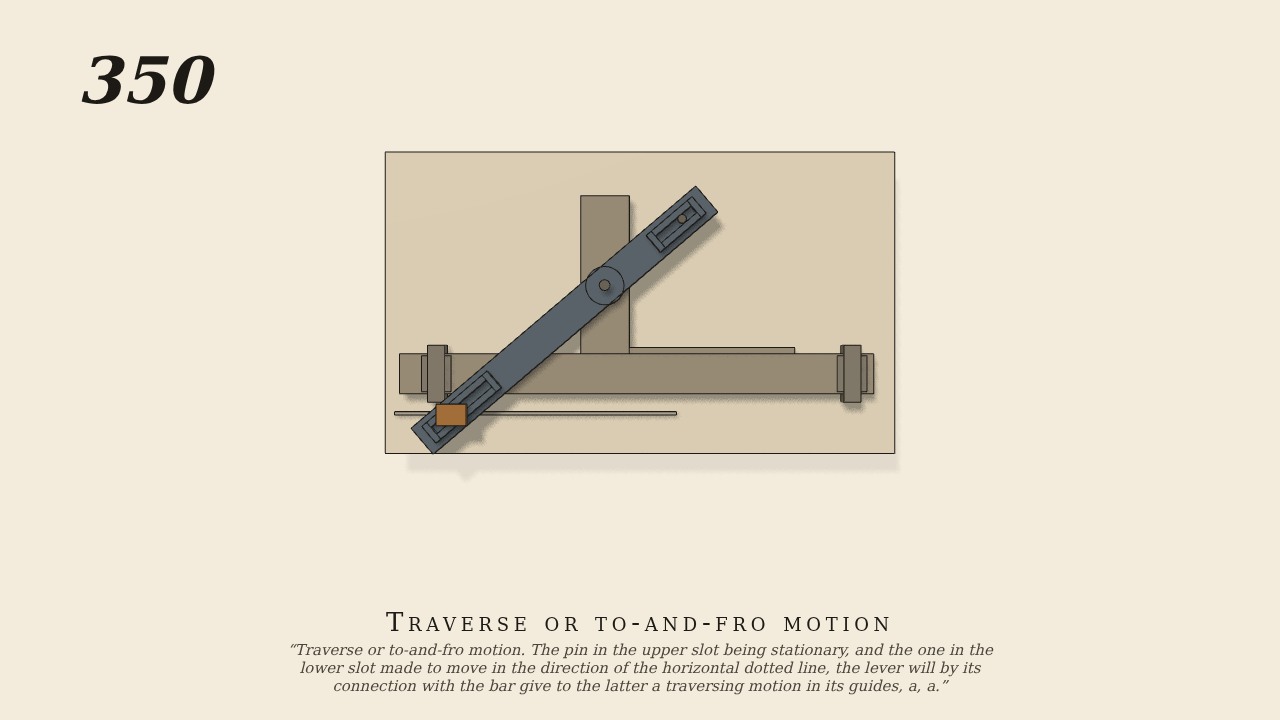
Traverse or to-and-fro motion
Traverse or to-and-fro motion. The pin in the upper slot being stationary, and the one in the lower slot made to move in the direction of the horizontal dotted line, the lever will by its connection with the bar give to the latter a traversing motion in its guides, a, a.
Only the input is driven; every other part of this model moves by physics (MuJoCo), and its ratios are measured. Run it live, change its parameters, or switch the friction off to see the output stop.
- Modelled as
- The bar slides in its guides a, a, 45 cm long. Its upright carries the lever's pivot 8.3 cm above the bar's middle line. The lever is 32 cm long and slotted at both ends. Its upper slot rides on the stationary pin in the frame, 6.2 cm above the pivot. Its lower slot takes the pin of a slide, 12.1 cm below the pivot, and the slide moves along the horizontal line. The pins are held in the slots only by contact, with 0.02 cm play. The slide is moved to and fro 4 cm either way every 4 seconds. It is the only driven part. A little friction in the guides stands for the bar's own resistance.
- Measured
- The lever turns about the stationary pin, so its pivot, and the bar with it, moves a fixed part of the lower pin's travel. That part is 6.2/18.3, the pivot's distance below the fixed pin over the lower pin's. The model gives 0.332 against 0.339, within 3%. The bar traverses about 1.3 cm each way while the lower pin goes 4 cm, and the lever tilts as the pins run along its slots. The deepest contact is 0.04 mm.
- Notes
- Brown gives no sizes, so the sizes are taken from the figure. The lower pin's slide is drawn as a small block on the dotted line. The friction in the guides (4 N) keeps the bar from being shaken along by the lever's own swing when nothing drives it.
Film (MP4) · Still (PNG) · Spec (YAML) · Model (MJCF)