Another form of parallel ruler
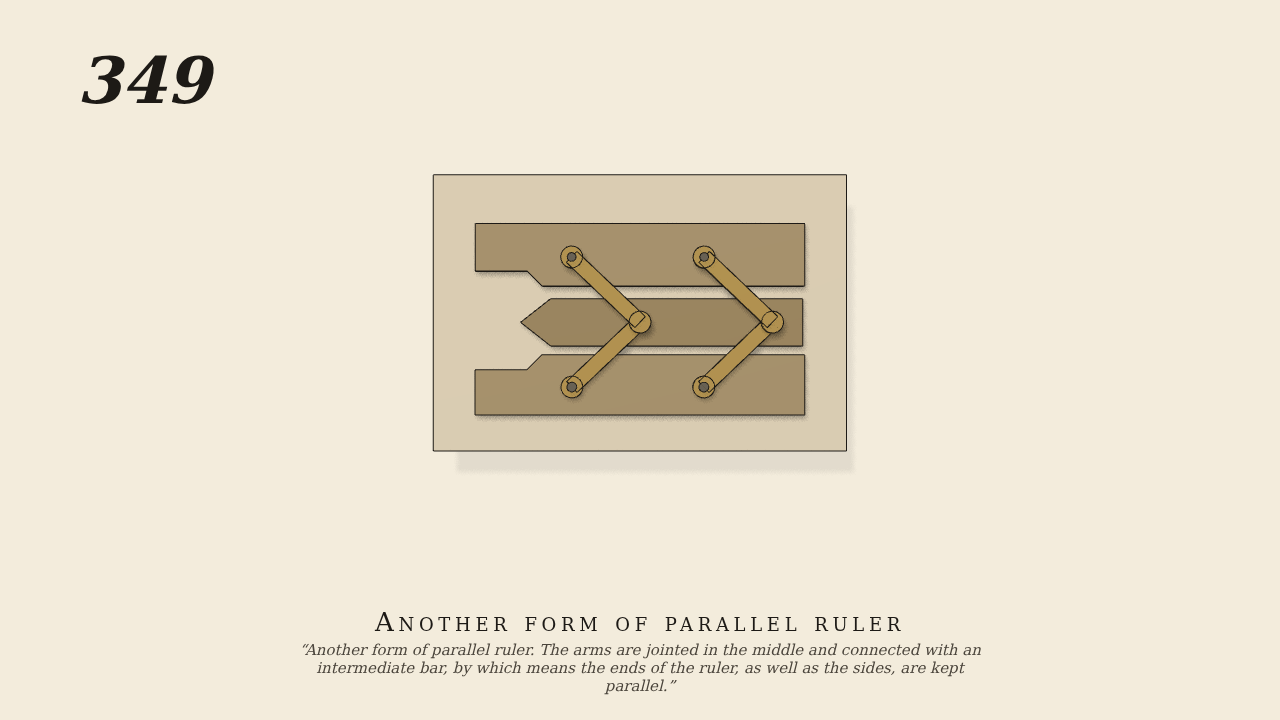
Another form of parallel ruler. The arms are jointed in the middle and connected with an intermediate bar, by which means the ends of the ruler, as well as the sides, are kept parallel.
Only the input is driven; every other part of this model moves by physics (MuJoCo), and its ratios are measured. Run it live, change its parameters, or switch the friction off to see the output stop.
- Modelled as
- Two rulers 30.6 cm long and 5.6 cm wide lie on the paper. The lower one is held down. Each arm is in two halves, 8.7 cm each, and the arms are pivoted 12.2 cm apart on each ruler. The joints in the middle of the arms are the pins of the intermediate bar. The left arm's lower half carries the bar. The right arm's lower half has a pin in the bar's eye, and so do both upper halves in the upper ruler's eyes. All are held only by contact, with 0.02 cm play. The hand draws the upper ruler straight off the lower one and back, 2.5 cm either way from 13.8 cm apart, every 4 seconds. This is the only driven part. It is a plan view, so there is no gravity.
- Measured
- The lower halves, the lower ruler and the bar make one parallelogram. The upper halves, the bar and the upper ruler make the other. The lower halves turn together, from 12 degrees one way to 17 degrees the other. The bar keeps square to the rulers, its turn on the left arm equal and opposite to the arm's to within 3%. The upper halves turn just as far the other way, so the arms open alike and the bar slides out sideways and back between the rulers. The deepest contact is 0.02 mm.
- Notes
- Brown gives no sizes, so the sizes are taken from the figure. The hand draws the upper ruler straight off the lower one, so its ends stay in line with the lower ruler's as well as its sides parallel. The two parallelograms alone would also let it shift endways, and the hand prevents that.
Film (MP4) · Still (PNG) · Spec (YAML) · Model (MJCF)