Mode of obtaining two reciprocating movements of a rod by one…
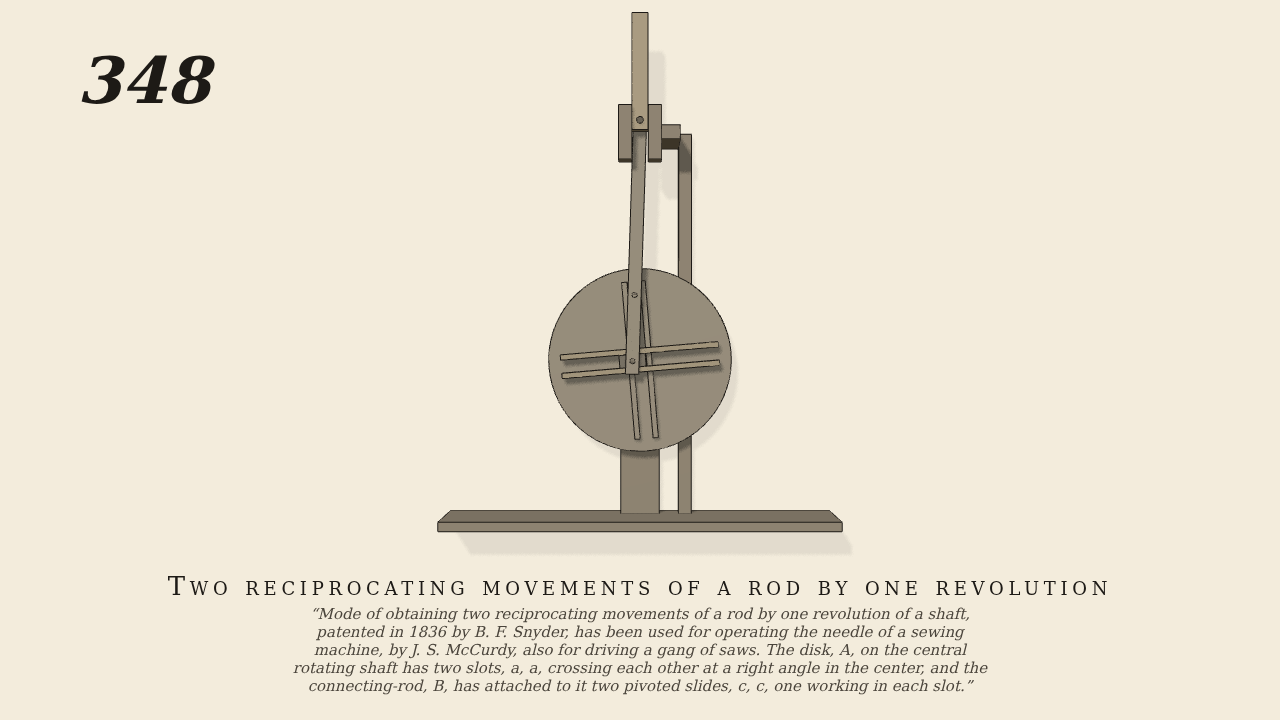
Mode of obtaining two reciprocating movements of a rod by one revolution of a shaft, patented in 1836 by B. F. Snyder, has been used for operating the needle of a sewing machine, by J. S. McCurdy, also for driving a gang of saws. The disk, A, on the central rotating shaft has two slots, a, a, crossing each other at a right angle in the center, and the connecting-rod, B, has attached to it two pivoted slides, c, c, one working in each slot.
Only the input is driven; every other part of this model moves by physics (MuJoCo), and its ratios are measured. Run it live, change its parameters, or switch the friction off to see the output stop.
- Modelled as
- The disk A, 28 cm across, turns on the central shaft. Its face carries the two slots a, a, 2 cm wide, crossing at a right angle at the centre. Each slot is a pair of cheeks standing out from the face, one slot's cheeks above the other's. The connecting-rod B carries the two pivoted slides c, c, 10 cm apart, one in each slot, each held there only by contact, with 0.02 cm play. B's upper end is pinned to the needle-bar, 26 cm above the upper slide, and the needle-bar slides up and down in its guide. The shaft is turned at 30 rev/min. It is the only driven part.
- Measured
- The slides, the ends of a trammel in the crossed slots, carry B's lower end round a small circle twice each turn. B works the needle-bar up and down through 10 cm, the slides' distance apart, twice to each turn of the disk: once a second at 30 rev/min. B leans up to 9 degrees either side. The deepest contact is 0.04 mm.
- Notes
- Brown gives no sizes. The slots are set one above the other on the disk's face rather than cut in one plane, so that each slide keeps to its own slot at the crossing. The needle or saws are left out.
Film (MP4) · Still (PNG) · Spec (YAML) · Model (MJCF)