Another arrangement of the Chinese windlass illustrated by 129 of…
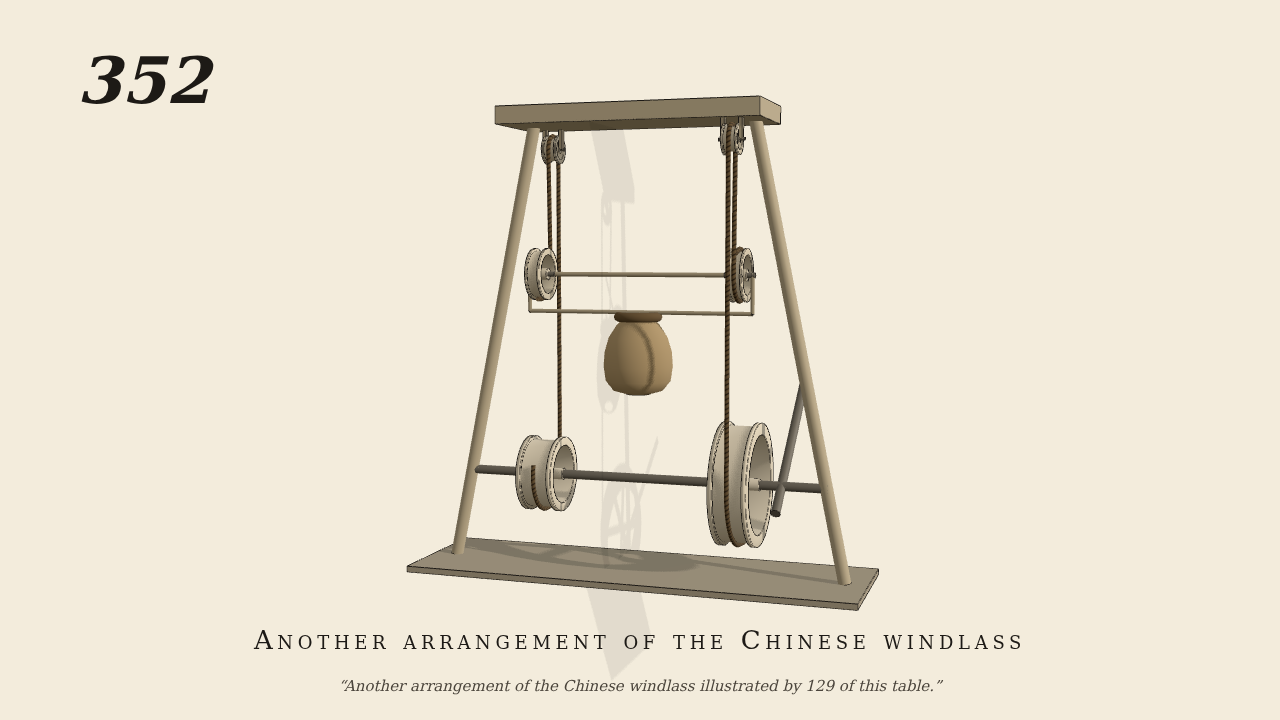
Another arrangement of the Chinese windlass illustrated by 129 of this table.
Only the input is driven; every other part of this model moves by physics (MuJoCo), and its ratios are measured. Run it live, change its parameters, or switch the friction off to see the output stop.
- Modelled as
- Seen as Brown: an A-frame with a barrel across it, turned by a handspike (the only input). The barrel carries two drums of different radii. The rope is made as two ropes pinned together at the hook pulley: one wound on each drum in opposite senses, so a turn winds one on as the other pays off. Each runs up over its fixed sheave at the head and down under its half of the hook pulley. The weight hangs from the hook. The ropes are elastic and grip the drums and sheaves only by friction (a capstan model, 1 ms step).
- Measured
- The hook falls by half the difference of the drums' circumferences each turn: it moves −0.0201 per radian of barrel (ideal −0.0200, r² 0.9999). With the ropes cut, the hook does not follow (0%).
- Notes
- Brown gives no sizes. Each rope lies in its own plane, so the hook pulley is a pair of sheaves on one block, not one sheave; the bell is drawn as a sack.
Film (MP4) · Still (PNG) · Spec (YAML) · Model (MJCF)