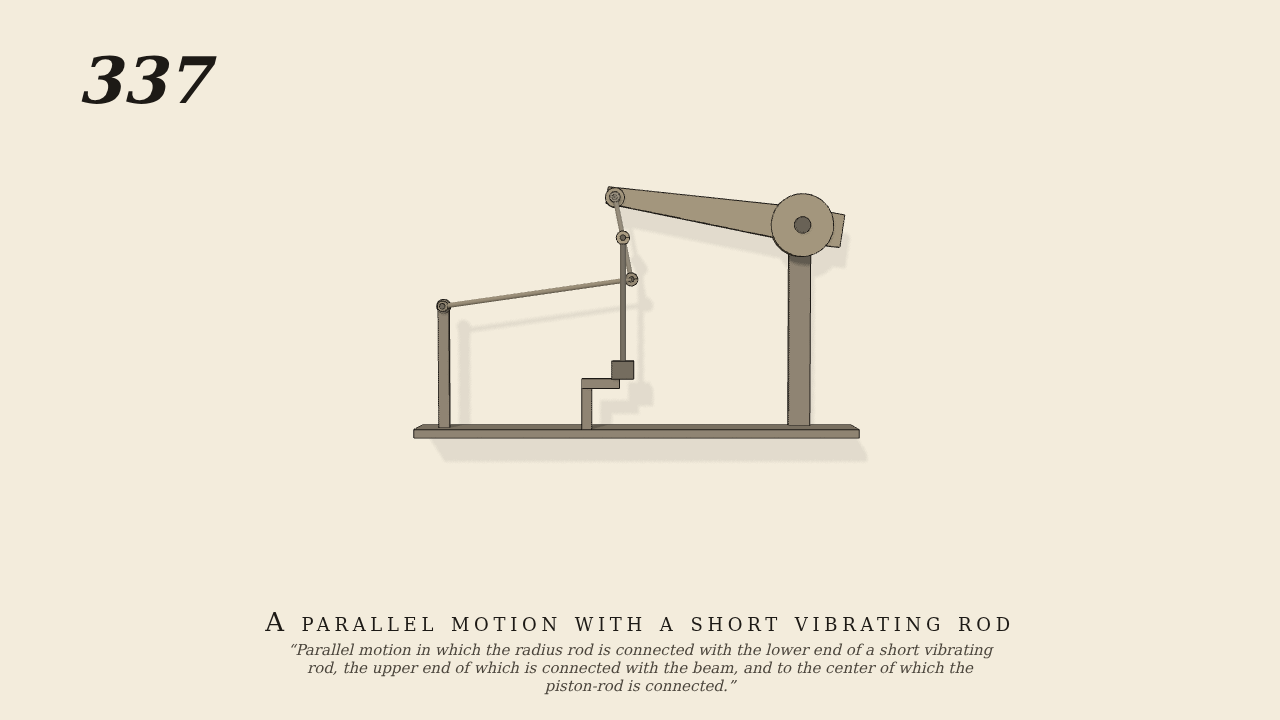
Parallel motion in which the radius rod is connected with the…
Parallel motion in which the radius rod is connected with the lower end of a short vibrating rod, the upper end of which is connected with the beam, and to the center of which the piston-rod is connected.
Only the input is driven; every other part of this model moves by physics (MuJoCo), and its ratios are measured. Run it live, change its parameters, or switch the friction off to see the output stop.
- Modelled as
- Watt's linkage. The beam turns on O and is rocked through 0.2 radian each way. The short vibrating rod, 12.4 cm long, hangs from the beam's end U, 28 cm from O. The radius rod runs from its lower end W to a fixed centre G, and is as long as the beam's radius. The piston-rod is pinned at the vibrating rod's centre C. Every joint is a pin in a ring with a few hundredths of a centimetre play. The cross-head is free to move up, down and across, and only the pin C places it. The beam is the only driven part.
- Measured
- The piston-rod rises and falls 11.2 cm, 0.279 m per radian of the beam, in step with it. The radius rod swings as far as the beam, the other way. C strays across by no more than 0.3 mm. The deepest contact is 0.007 mm.
- Notes
- Brown gives no sizes. The figure's radius rod is shorter than the beam's radius. With rods of unequal length, the straight-moving point is not at the vibrating rod's centre. Brown puts the piston-rod at the centre, so the radius rod here is made as long as the beam's radius. The vibrating rod leans as drawn; on paper C then keeps within 0.5 mm of its line. No steam is simulated. The drive is stiff enough to hold the beam's weight.
Film (MP4) · Still (PNG) · Spec (YAML) · Model (MJCF)