The piston-rod is prolonged and works in a guide, A, which is in…
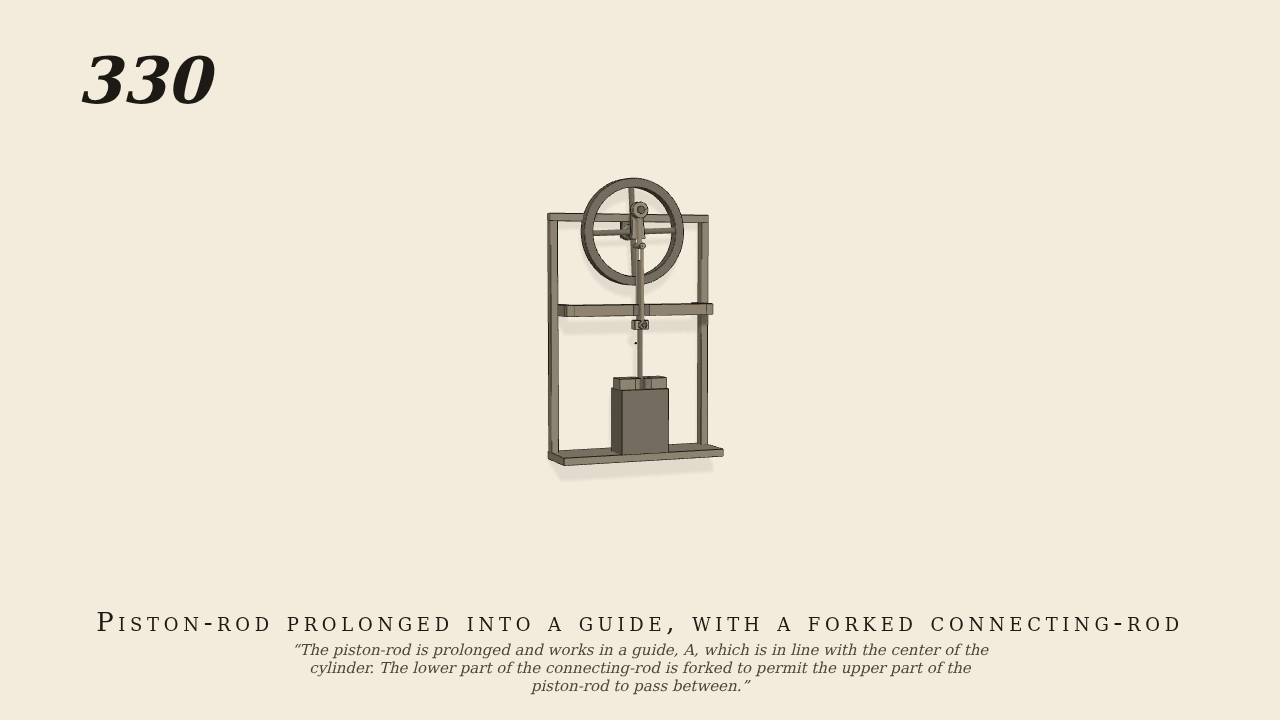
The piston-rod is prolonged and works in a guide, A, which is in line with the center of the cylinder. The lower part of the connecting-rod is forked to permit the upper part of the piston-rod to pass between.
Only the input is driven; every other part of this model moves by physics (MuJoCo), and its ratios are measured. Run it live, change its parameters, or switch the friction off to see the output stop.
- Modelled as
- A vertical engine with the crank at the top: a 3 cm crank with a fly-wheel, turned at 30 rpm, and a connecting-rod 16 cm long, its big end a bearing ring round the crank-pin. The piston-rod runs from the cylinder's gland below, through the cross-head, and on up 9 cm into guide A, which is in line with the gland (both with 0.02 cm clearance). The connecting-rod's lower part is a fork 11 cm long. Its tines take the cross-head pin on either side of the piston-rod, and the rod's prolonged end passes up between them. Guide A's bracket also passes between the tines. The piston-rod is free to move across, up and down and to turn. Only the gland and guide A hold it.
- Measured
- The piston-rod runs its full 6 cm stroke, twice the crank. It stays within 0.2 mm of its line, held at both ends, and turns less than 0.2 degrees. The deepest contact is 0.004 mm.
- Notes
- Brown gives no sizes. The crank, the rod lengths, the fork's length and the guide's height are choices. Brown's figure has no steam; a fly-wheel keeps the crank turning evenly.
Film (MP4) · Still (PNG) · Spec (YAML) · Model (MJCF)