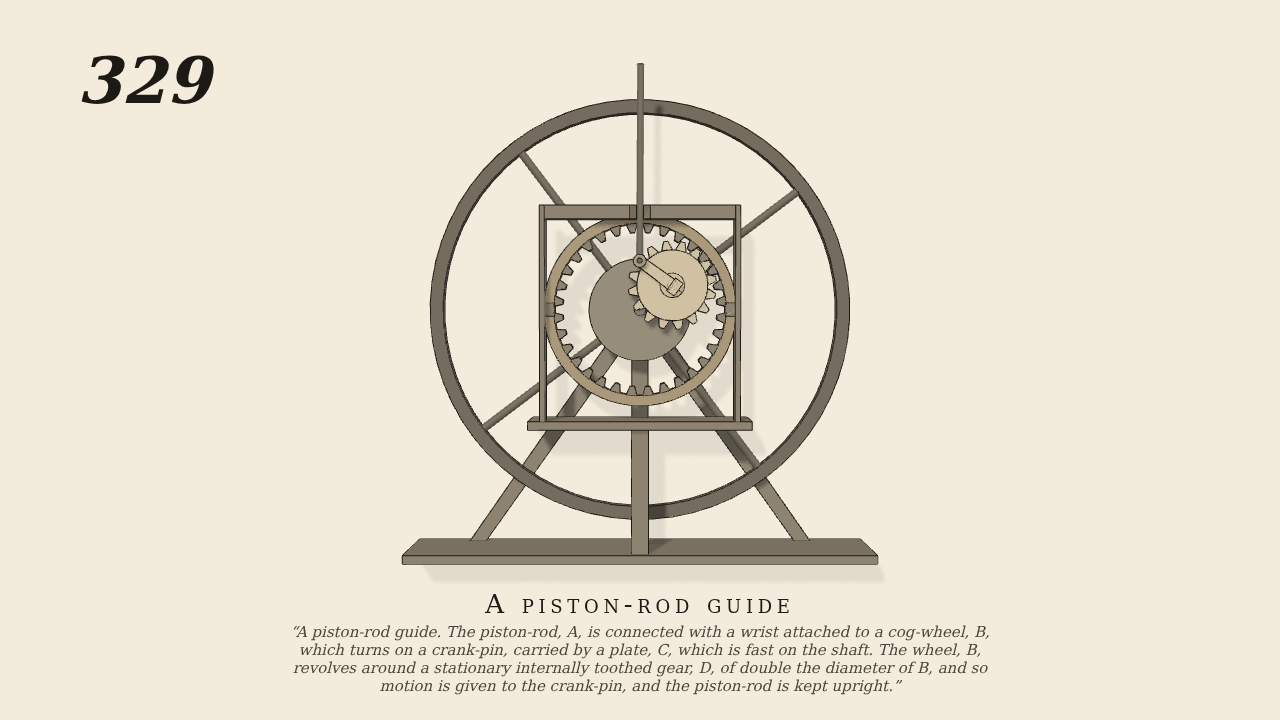
A piston-rod guide
A piston-rod guide. The piston-rod, A, is connected with a wrist attached to a cog-wheel, B, which turns on a crank-pin, carried by a plate, C, which is fast on the shaft. The wheel, B, revolves around a stationary internally toothed gear, D, of double the diameter of B, and so motion is given to the crank-pin, and the piston-rod is kept upright.
Only the input is driven; every other part of this model moves by physics (MuJoCo), and its ratios are measured. Run it live, change its parameters, or switch the friction off to see the output stop.
- Modelled as
- A stationary internally toothed gear D, 32 teeth of module 0.6 (19.2 cm across), is fixed in the frame. Plate C, fast on the shaft with a fly-wheel behind it, is turned at 30 rpm and carries a crank-pin 4.8 cm from the centre. Cog-wheel B, 16 teeth (half D's diameter), turns on the crank-pin: its hub is a bearing ring round the pin, and B is otherwise free to move across, up and down and to turn. Only the pin and the teeth hold it. The wrist is on B's pitch circle. The piston-rod A is pinned to the wrist, is free to move and turn, and passes up through a gland with 0.02 cm clearance. The teeth are straight-flanked.
- Measured
- B turns backwards once for each turn of the plate (ratio -1.0005). The wrist runs up and down a diameter of D, a 19.2 cm stroke (four times the crank), and stays within 0.55 mm of the line. The piston-rod tilts no more than its play in the gland allows (1.3 degrees). The deepest contact is 0.03 mm.
- Notes
- Brown gives no sizes; the module, the tooth form, the crank and the gland are choices. The gland stands in for the piston in its cylinder. The wrist's straight path comes from the wheels: the gland only keeps the rod from falling over on its pin. B's slides and the rod's pivot have light damping, so that with the contact off the loose parts come to rest.
Film (MP4) · Still (PNG) · Spec (YAML) · Model (MJCF)