A parallel motion invented by Dr
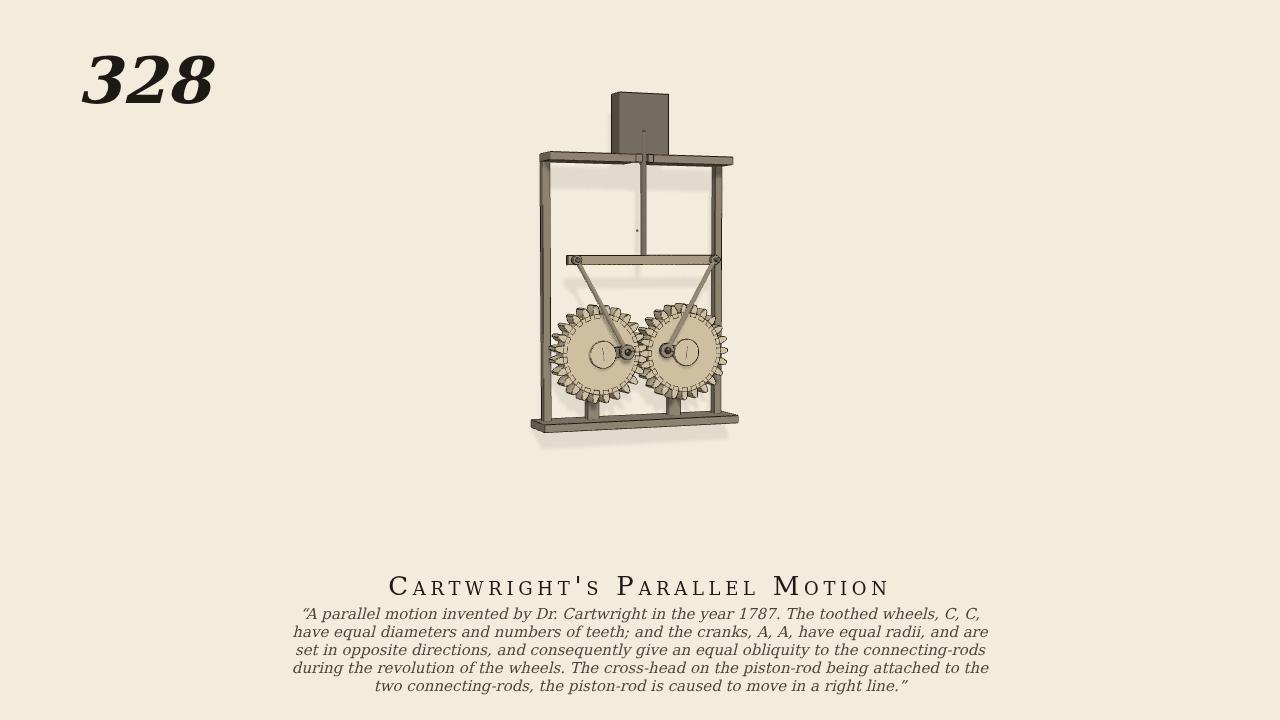
A parallel motion invented by Dr. Cartwright in the year 1787. The toothed wheels, C, C, have equal diameters and numbers of teeth; and the cranks, A, A, have equal radii, and are set in opposite directions, and consequently give an equal obliquity to the connecting-rods during the revolution of the wheels. The cross-head on the piston-rod being attached to the two connecting-rods, the piston-rod is caused to move in a right line.
Only the input is driven; every other part of this model moves by physics (MuJoCo), and its ratios are measured. Run it live, change its parameters, or switch the friction off to see the output stop.
- Modelled as
- Two equal spur wheels C, C, 24 teeth of module 0.5 (12 cm across), mesh side by side, 12 cm apart. Each carries a 3 cm crank A; the cranks are set opposite, so they are mirror images of each other. The left wheel is turned at 30 rpm with a fly-wheel; the right wheel is turned only through the teeth. Two equal connecting-rods, 14 cm long, run from the crank-pins up to the ends of a cross-head 20 cm wide; each end is a bearing ring round its pin. The cross-head is free to move across, up and down and to turn. The piston-rod rises from its middle through a stuffing-box on the frame, 9 cm above, with 0.02 cm clearance.
- Measured
- The wheels turn at the same speed in opposite ways (ratio -0.9998). The cross-head runs a stroke of about 6.3 cm and stays within 0.3 mm of its line, turning less than 0.11 degrees. The stuffing-box is touched only now and then, with forces near 1 N; the rods hold the line. The deepest contact is 0.9 mm, between the wheel teeth, as the driven wheel rattles in its backlash.
- Notes
- Brown gives no sizes; all of them are choices. Brown says the rods alone keep the piston-rod straight. In the simulation the four-bar of cranks, rods and cross-head can still sway sideways a little within its pin clearances, and without the stuffing-box it drifts to a stop. So the piston-rod passes through a stuffing-box, as in a real engine. The cross-head slides have light damping (0.2), and the driven wheel has a light bearing load so its teeth stay in contact.
Film (MP4) · Still (PNG) · Spec (YAML) · Model (MJCF)