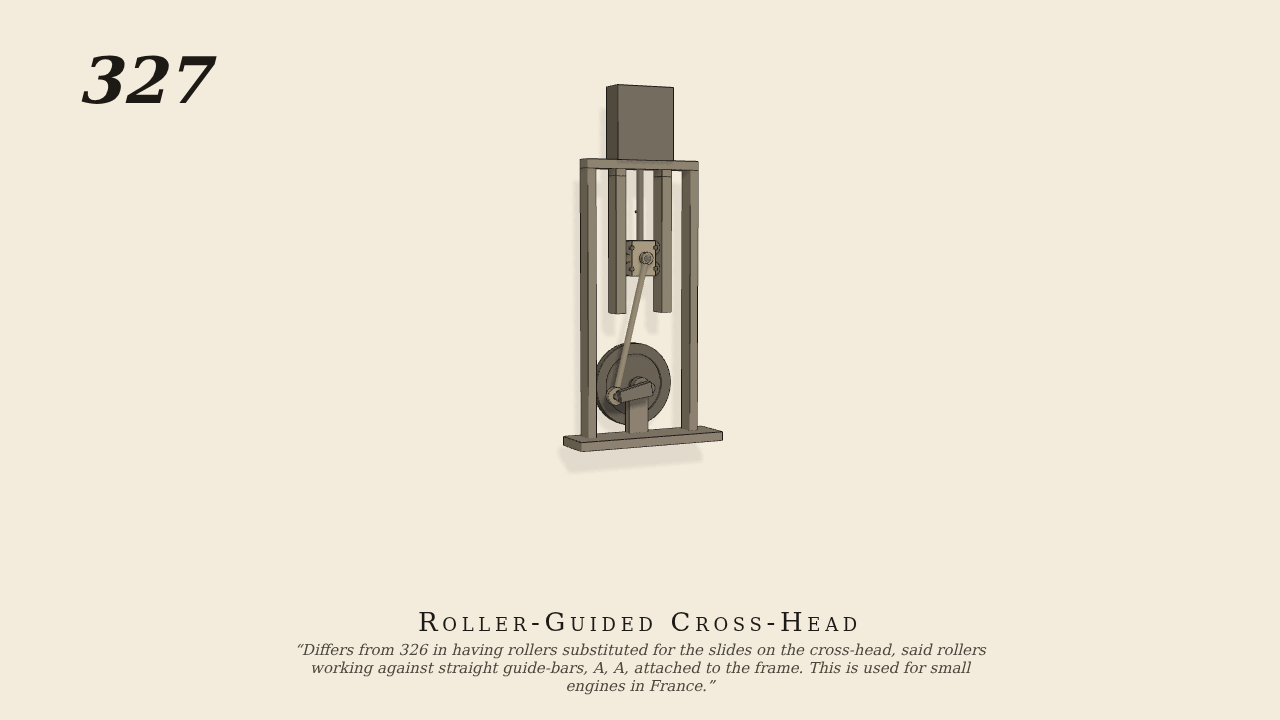
Differs from 326 in having rollers substituted for the slides on…
Differs from 326 in having rollers substituted for the slides on the cross-head, said rollers working against straight guide-bars, A, A, attached to the frame. This is used for small engines in France.
Only the input is driven; every other part of this model moves by physics (MuJoCo), and its ratios are measured. Run it live, change its parameters, or switch the friction off to see the output stop.
- Modelled as
- The same engine as No. 326: a 4 cm crank with a fly-wheel, turned at 30 rpm, and a connecting-rod 16 cm long, its big end a bearing ring round the crank-pin. The slide is replaced by a cross-head carrying four steel rollers, 1.6 cm across, two at each side on their own pins. The rollers bear on two straight guide-bars A, A fixed to the frame, set 0.003 cm into them as a light preload (friction 0.5). The cross-head is free to move across, up and down and to turn. Only the rollers on the bars hold it.
- Measured
- The cross-head runs its full 8 cm stroke. The rollers roll and do not slide: each turns 125.2 rad per metre of stroke (1/r = 125.5 less the preload), the two sides opposite ways. The cross-head stays within 0.00002 mm of its line and does not measurably turn. The deepest contact is 0.03 mm.
- Notes
- Brown gives no sizes. The engine is No. 326's; the rollers, their spacing and the preload are choices. The rollers' pins carry almost no friction, so in the negative control they keep spinning on their own. That is why the control is read on the cross-head, not on a roller.
Film (MP4) · Still (PNG) · Spec (YAML) · Model (MJCF)