A simple means of guiding or obtaining a parallel motion of the…
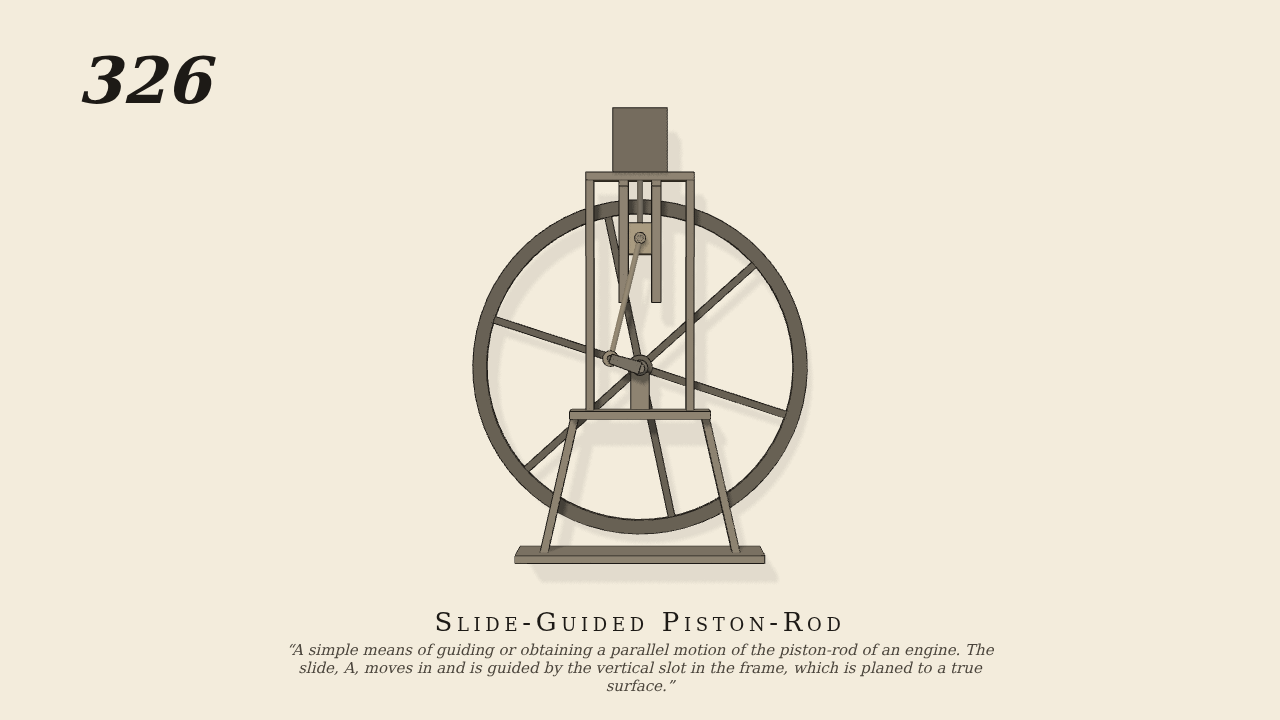
A simple means of guiding or obtaining a parallel motion of the piston-rod of an engine. The slide, A, moves in and is guided by the vertical slot in the frame, which is planed to a true surface.
Only the input is driven; every other part of this model moves by physics (MuJoCo), and its ratios are measured. Run it live, change its parameters, or switch the friction off to see the output stop.
- Modelled as
- A side view of a small vertical engine. A crank of 4 cm radius with a fly-wheel drives a connecting-rod 16 cm long. Its big end is a bearing ring round the crank-pin, and its small end is pinned to the slide A, a steel block 3 cm wide and 4 cm tall carrying the piston-rod up into the cylinder. A is free to move across, up and down and to turn. It is kept on its line only by the two guide bars of the vertical slot in the frame, which clear it by 0.01 cm a side (friction 0.05). The only input is the crank, turned at 30 rpm.
- Measured
- A runs up and down its full 8 cm stroke and follows the crank-and-rod law within 0.23 mm. The rod pushes it sideways twice a turn. The guide bars hold it within 0.01 cm of its line and let it turn by no more than 0.14°, the play in the slot. The deepest contact is 0.006 mm.
- Notes
- Brown gives no sizes. The crank, rod, slide and clearance are choices, and the steam is not modelled: the crank is turned and the slide is lifted against its weight. The fly-wheel is there to steady the crank against the slide's weight.
Film (MP4) · Still (PNG) · Spec (YAML) · Model (MJCF)