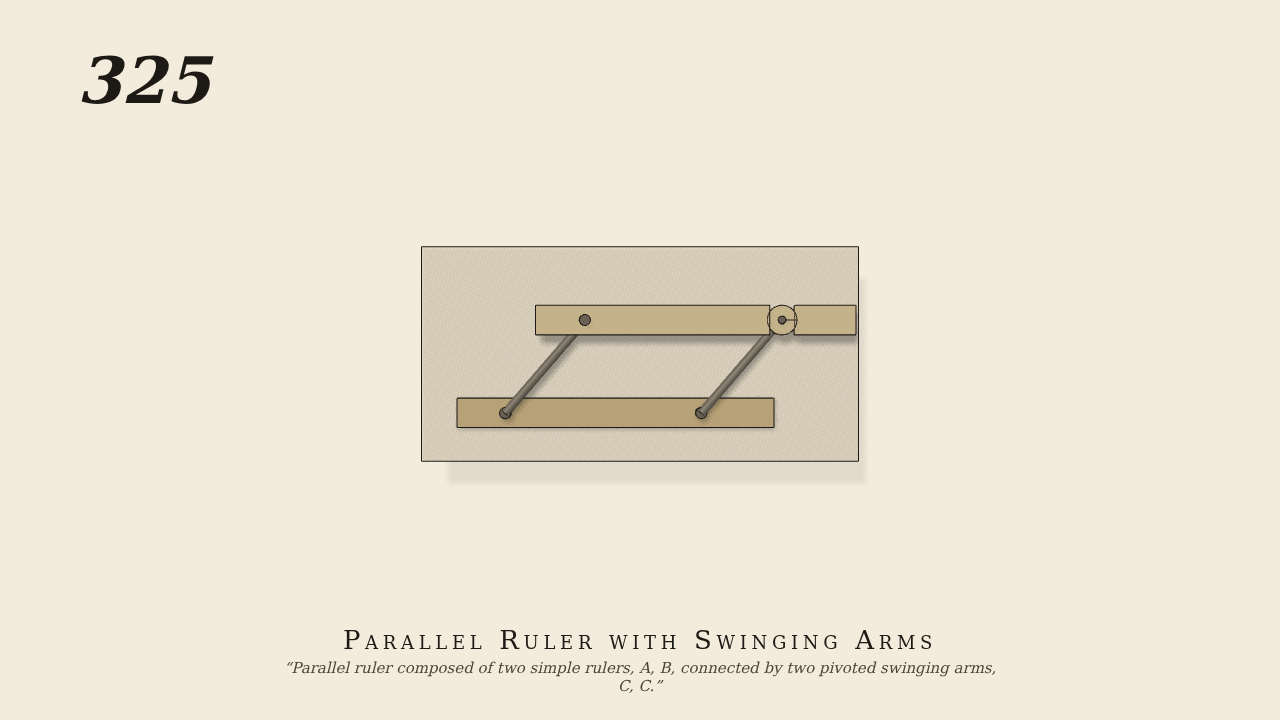
Parallel ruler composed of two simple rulers, A, B, connected by…
Parallel ruler composed of two simple rulers, A, B, connected by two pivoted swinging arms, C, C.
Only the input is driven; every other part of this model moves by physics (MuJoCo), and its ratios are measured. Run it live, change its parameters, or switch the friction off to see the output stop.
- Modelled as
- A plan of the drawing board, gravity off. Two rulers A and B, 26 by 2.4 cm. A is held down on the paper. Two arms C, C, 10 cm long and 16 cm apart, are pivoted on A. B is pivoted on the first arm's upper end. The second arm's upper end is a pin 0.6 cm across, turning in a 0.64 cm hole in B. The only input is the hand swinging the first arm, ±14.3° about 60° at 0.25 Hz. B and the second arm are moved only by the pin bearing in the hole.
- Measured
- A, B and the arms make a parallelogram. The second arm swings with the first, 1.00 of its angle (within 0.12°, the pin's play in its hole). B turns back on its arm by 1.00 of the arm's swing, so it stays parallel to A within 0.08° as it moves across the paper and along it. The deepest contact is 0.02 mm.
- Notes
- Brown gives no sizes. The rulers, the arms and their spacing, the swing and the pin's clearance are choices. Unlike No. 324, B's ends move along A as the ruler opens. The pivots carry light damping, which only matters in the negative control.
Film (MP4) · Still (PNG) · Spec (YAML) · Model (MJCF)