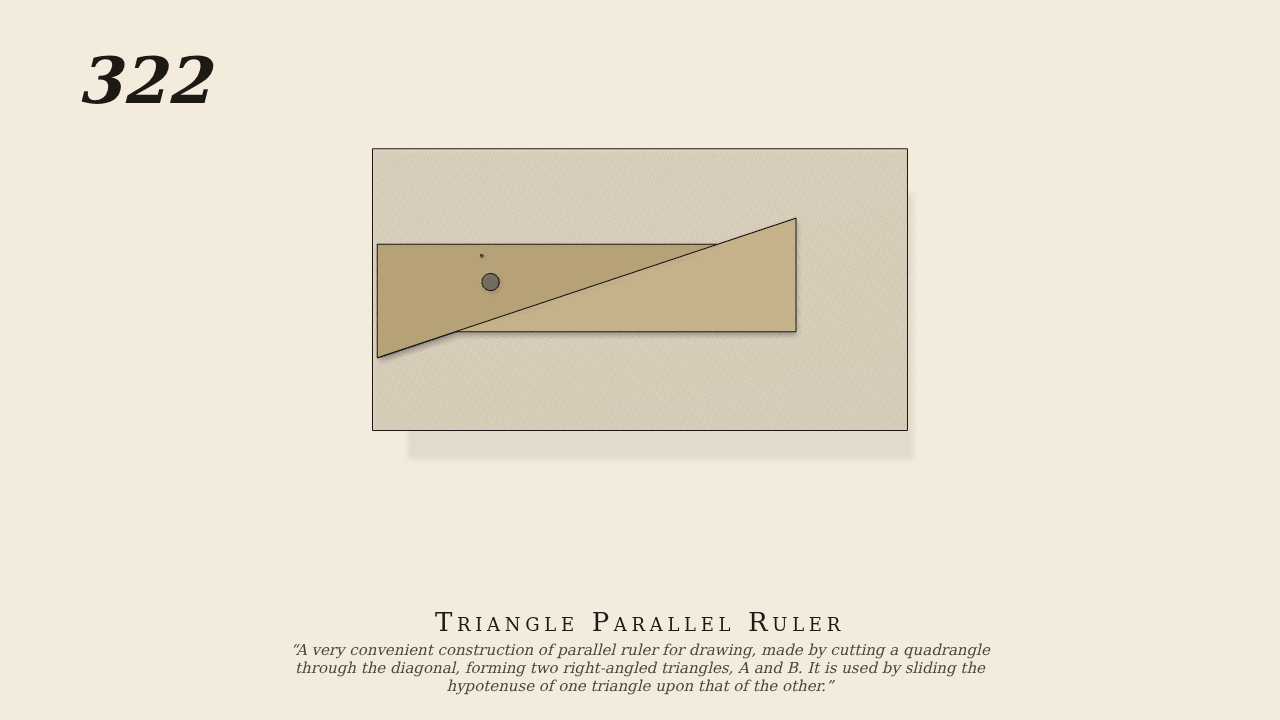
A very convenient construction of parallel ruler for drawing, made…
A very convenient construction of parallel ruler for drawing, made by cutting a quadrangle through the diagonal, forming two right-angled triangles, A and B. It is used by sliding the hypotenuse of one triangle upon that of the other.
Only the input is driven; every other part of this model moves by physics (MuJoCo), and its ratios are measured. Run it live, change its parameters, or switch the friction off to see the output stop.
- Modelled as
- A plan of the drawing board, gravity off. A 24 by 8 cm quadrangle is cut on its diagonal into two right-angled triangles. B, the lower one, is held down on the paper. A lies free on the paper: it can slide either way and turn. The fingers' pressure that keeps A on B's edge is a light spring (0.3 N) across the cut. The only input is the hand moving A to and fro along the paper, ±6 cm at 0.25 Hz. A is kept on its line only by its hypotenuse bearing on B's (friction 0.08).
- Measured
- Sliding on B's edge, A moves across the cut by −0.316 of its travel along the paper, both ways of the stroke (−0.3162 from the 8-in-24 cut). It does not turn: its edges stay parallel to where they started, within 0.003°. The deepest contact is 0.03 mm.
- Notes
- Brown gives no sizes. The triangles' size, the pressure and the stroke are choices. The hand is modelled as a push along the paper plus a light press against B; how a draughtsman's fingers share the two is not modelled.
Film (MP4) · Still (PNG) · Spec (YAML) · Model (MJCF)