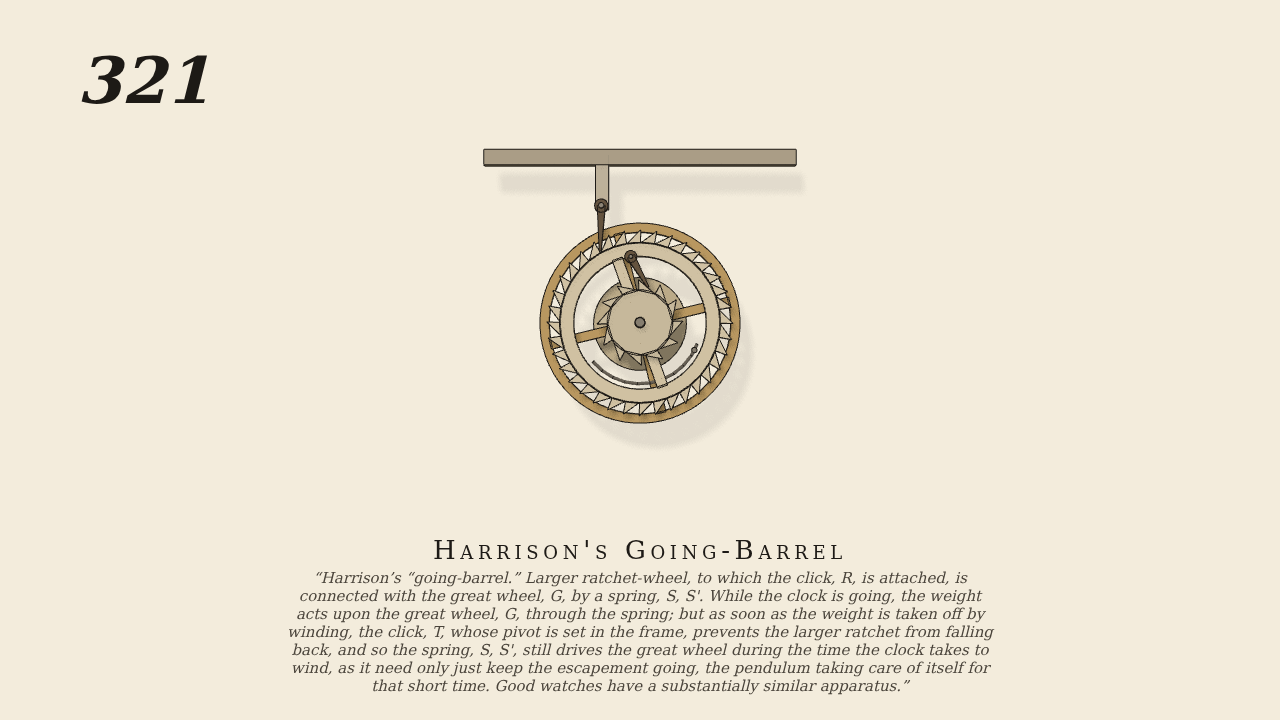
Harrison’s “going-barrel.” Larger ratchet-wheel, to which the…
Harrison’s “going-barrel.” Larger ratchet-wheel, to which the click, R, is attached, is connected with the great wheel, G, by a spring, S, S'. While the clock is going, the weight acts upon the great wheel, G, through the spring; but as soon as the weight is taken off by winding, the click, T, whose pivot is set in the frame, prevents the larger ratchet from falling back, and so the spring, S, S', still drives the great wheel during the time the clock takes to wind, as it need only just keep the escapement going, the pendulum taking care of itself for that short time. Good watches have a substantially similar apparatus.
Only the input is driven; every other part of this model moves by physics (MuJoCo), and its ratios are measured. Run it live, change its parameters, or switch the friction off to see the output stop.
- Modelled as
- A plan of the movement, gravity off, all wheels on one arbor. The barrel (the weight's drum) carries a 12-tooth ratchet. The larger ratchet (36 teeth) carries the click R, which bears on the barrel's ratchet, and is joined to the great wheel G by the spring S, S' (a hinge spring of 0.02 N m/rad between the two). The click T is pivoted in the frame and bears on the larger ratchet. The going train is stood in for by a damper of 0.05 N m s on G. The only input is the barrel. A hand rocks it 0.6 rad each way at 0.25 Hz: the forward stroke is the weight driving, the back stroke is winding, which takes the weight off.
- Measured
- From 3.5 s on, G turns forward the whole time at 0.113 rad/s on average. It never runs back, and its slowest is about 0.045 rad/s, at the end of each winding stroke. The spring stays bent between 0.08 and 0.6 rad. During winding T holds the larger ratchet (it drops back at most one tooth onto T) and R clicks over the barrel's teeth. During driving T clicks over the larger ratchet's teeth. The deepest contact is under 0.5 mm.
- Notes
- Brown gives no sizes. The wheels, the spring and the load are choices. The weight and the winding are both the barrel's one driven arbor, rocked to and fro: forward under the weight, back when wound. Without an escapement, G's speed follows the spring's bend, so it slows during winding and does not hold steady. The spring is a hinge spring between the larger ratchet and G, drawn as a curved strip.
Film (MP4) · Still (PNG) · Spec (YAML) · Model (MJCF)