Endless chain, maintaining power on going-barrel, to keep a clock…
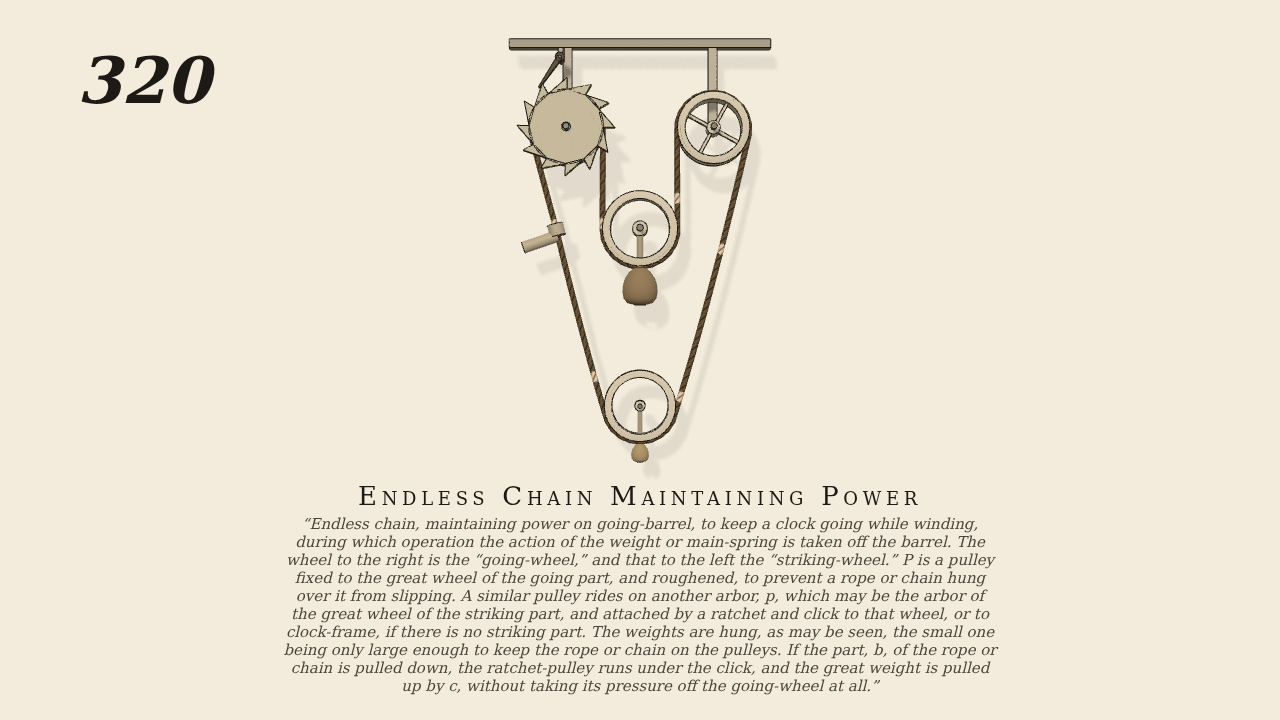
Endless chain, maintaining power on going-barrel, to keep a clock going while winding, during which operation the action of the weight or main-spring is taken off the barrel. The wheel to the right is the “going-wheel,” and that to the left the “striking-wheel.” P is a pulley fixed to the great wheel of the going part, and roughened, to prevent a rope or chain hung over it from slipping. A similar pulley rides on another arbor, p, which may be the arbor of the great wheel of the striking part, and attached by a ratchet and click to that wheel, or to clock-frame, if there is no striking part. The weights are hung, as may be seen, the small one being only large enough to keep the rope or chain on the pulleys. If the part, b, of the rope or chain is pulled down, the ratchet-pulley runs under the click, and the great weight is pulled up by c, without taking its pressure off the going-wheel at all.
Only the input is driven; every other part of this model moves by physics (MuJoCo), and its ratios are measured. Run it live, change its parameters, or switch the friction off to see the output stop.
- Modelled as
- A front view, under gravity. The going pulley P (right, r 4.5 cm) is fixed on the great wheel of the going part. The going train is stood in for by a damper of 8 N m s on its arbor. The pulley p (left, the same size) is keyed to a 12-tooth ratchet with a sprung click held on the frame. One endless chain, a ring of 120 iron links lying on the rims by real contact and friction (0.8), runs from the hand up over p, down under the great weight's sheave (4 kg), up over P, down under the small weight's sheave (0.5 kg) and back up to the hand. The hand holds the part b of the chain and is the only driven joint: it draws b down at 2 cm/s.
- Measured
- p turns 19.95 rad per metre of hand against 20.41 from its 4.9 cm pitch radius (2% short from the chain's stretch), always forwards, and the click rises and falls on each tooth. The great weight climbs 0.36 cm per cm of hand. Meanwhile P keeps turning forwards at a steady 0.110 rad/s, the same rate it had before the winding, because the great weight still hangs on its strand c and P's pull is never taken off. The deepest contact is 0.50 mm, from the chain's chords on the rims.
- Notes
- Brown gives no sizes. The pulleys, weights, ratchet and chain are choices. The great wheel, the striking wheel and the rest of the train are not modelled: the going train is a damper on P, so P's steady speed shows the pressure on it without an escapement. The small weight only keeps the chain on the pulleys, as Brown says. The 'roughened' pulley is friction 0.8 on the rims. The run starts with the hand already winding.
Film (MP4) · Still (PNG) · Spec (YAML) · Model (MJCF)