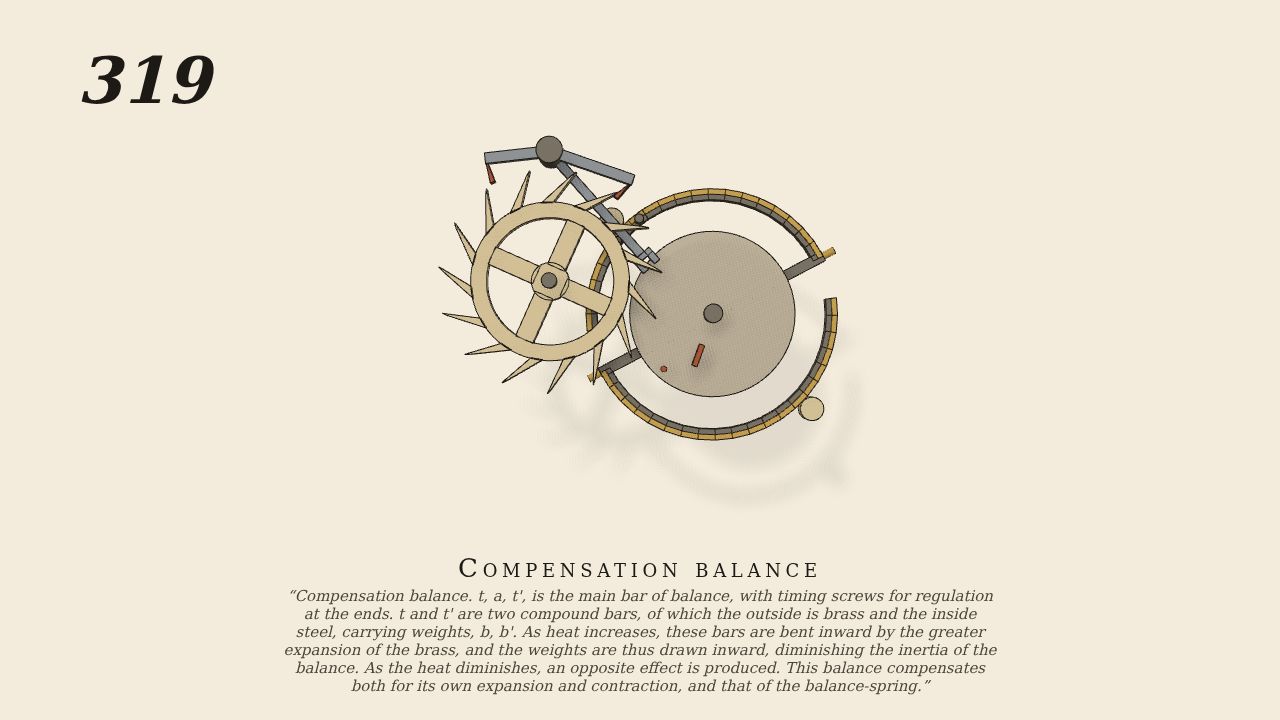
Compensation balance
Compensation balance. t, a, t', is the main bar of balance, with timing screws for regulation at the ends. t and t' are two compound bars, of which the outside is brass and the inside steel, carrying weights, b, b'. As heat increases, these bars are bent inward by the greater expansion of the brass, and the weights are thus drawn inward, diminishing the inertia of the balance. As the heat diminishes, an opposite effect is produced. This balance compensates both for its own expansion and contraction, and that of the balance-spring.
Only the input is driven; every other part of this model moves by physics (MuJoCo), and its ratios are measured. Run it live, change its parameters, or switch the friction off to see the output stop.
- Modelled as
- A plan of the watch, gravity off. The watch is the lever chronometer escapement of No. 314, with its plain balance changed for a compensation balance of the same size. The main bar t a t' is steel, with a brass timing screw standing out at each end. From each end runs a compound bar 160° round the balance, 0.3 thick, brass outside and steel inside, free at its far end. Each carries a brass weight (b, b') 109° from its root. Heat is not simulated. The weights' place is the one that compensates. Warmed one degree, each bar's curvature grows by 1.5 × (19 − 11.5)×10⁻⁶ / 0.3 per cm, which draws a point ψ along it in by 4.08×10⁻⁴ (1 − cos ψ) cm. That takes 2.28×10⁻⁴ off the balance's inertia (relative). It pays for the balance's own expansion (+2.3×10⁻⁵) and for the spring's loss of stiffness (2.06×10⁻⁴: its modulus falls 2.4×10⁻⁴ a degree, less 3 × 11.5×10⁻⁶ for its own growth), so the period stays put. The only input is the mainspring's constant torque on the escape-wheel. The balance is let go 2 rad from rest.
- Measured
- The balance's period is 0.9741 s against 0.9721 s from 2π√(I/k), with the model's own inertia (6.70×10⁻⁵ kg m²) and No. 314's spring (0.0028 N m/rad). The escape-wheel goes 0.2094 rad per beat over 16 beats (0.2094 expected: 24° every two beats). The swing holds at about 110° (first third 112°, last third 107°). The deepest contact is 0.32 mm.
- Notes
- Brown gives no sizes. The bars, the weights and their places are choices. The weights' angle along the bars is solved from the expansion figures (brass 19×10⁻⁶ and steel 11.5×10⁻⁶ per degree), the bending rule for a bar of two equal layers, and a figure of 2.4×10⁻⁴ per degree for the fall of the steel spring's elasticity. Temperature itself is not in the simulation: the model is the watch at one temperature, and the compensation is the arithmetic of its proportions. The escapement and its timing are No. 314's, including its unequal pallets (20° and 4°), so the advance is counted over an even number of beats.
Film (MP4) · Still (PNG) · Spec (YAML) · Model (MJCF)