Watch regulator
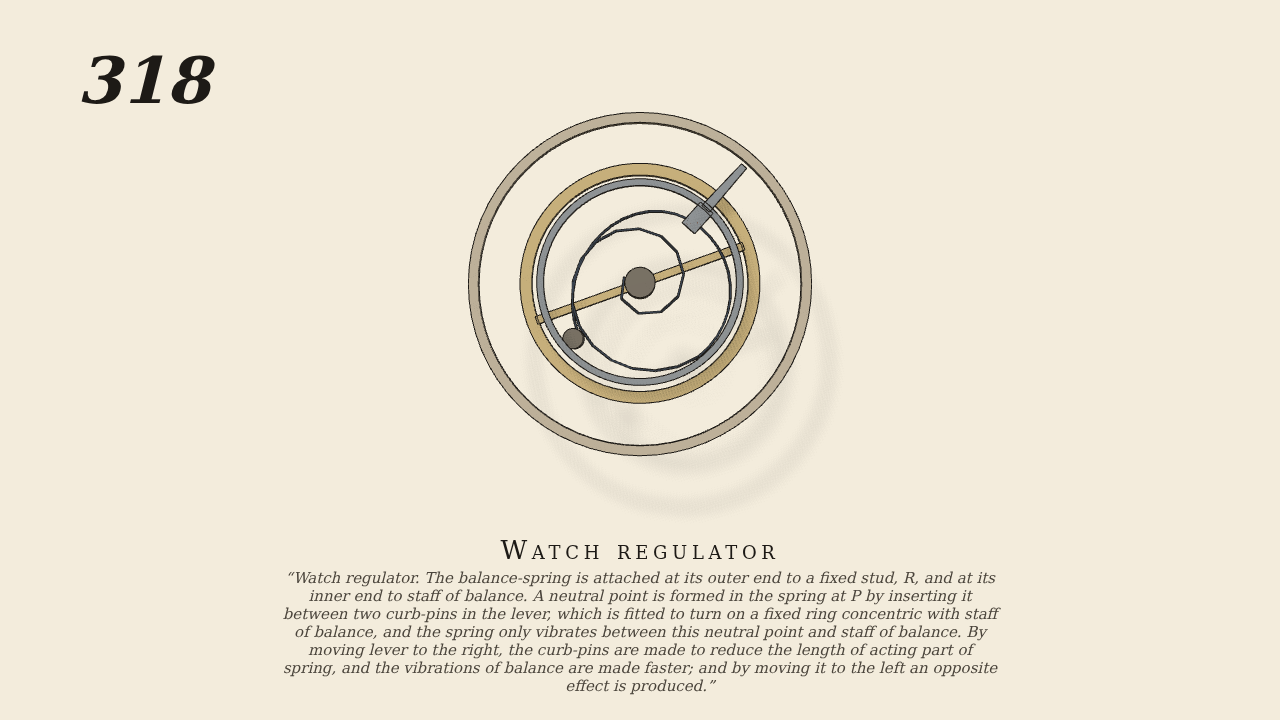
Watch regulator. The balance-spring is attached at its outer end to a fixed stud, R, and at its inner end to staff of balance. A neutral point is formed in the spring at P by inserting it between two curb-pins in the lever, which is fitted to turn on a fixed ring concentric with staff of balance, and the spring only vibrates between this neutral point and staff of balance. By moving lever to the right, the curb-pins are made to reduce the length of acting part of spring, and the vibrations of balance are made faster; and by moving it to the left an opposite effect is produced.
Only the input is driven; every other part of this model moves by physics (MuJoCo), and its ratios are measured. Run it live, change its parameters, or switch the friction off to see the output stop.
- Modelled as
- A plan of the watch, gravity off. The balance (10 g, a rim of radius 3.6 cm) turns on its staff at the centre. Its spring is a chain of 47 short steel links, each hinged to the next with the stiffness of that much spring (EI/l, with EI 7×10⁻⁵ N m²). Twenty links make a 1.5-turn spiral from the collet (r 0.5 cm) out to r 2.4 cm. The other 27 lie on an arc concentric with the balance (260°) out to the stud R, where the last link is pinned. The lever turns on the same centre and carries the two curb pins P, one each side of the arc, set 6° apart along it with no play. The pins are the only things the lever touches. The lever is the only driven joint: a hand moves it 50° to the right, back, and 50° to the left over 16 s. The balance is let go 1.2 rad from rest, with the spring wound evenly along its acting part, and nothing else drives it.
- Measured
- With the lever to the right (2.5 to 5.5 s) the acting part is about 17.2 cm and the balance's period is 0.889 s, against 0.896 s from T = 2π√(I L / EI) with the model's own I. With the lever to the left (10.5 to 13.5 s) the acting part is about 21.4 cm and the period is 0.982 s against 0.993 s. So moving the lever right makes the vibrations faster, as Brown says. The swing is about 74° and dies slowly, since there is no escapement. The deepest contact is 0.25 mm.
- Notes
- Brown gives no sizes. The spring, the balance and the lever's travel are choices, much larger than a real watch's so that the change of rate is plain. The spring is modelled as hinged links, and its own small mass is included. The pins are set a little apart along the spring so that they hold its direction as well as its place, as curb pins with no play do. The expected periods average the formula over each window, because the lever is still moving slowly there.
Film (MP4) · Still (PNG) · Spec (YAML) · Model (MJCF)