Compound bar compensation pendulum
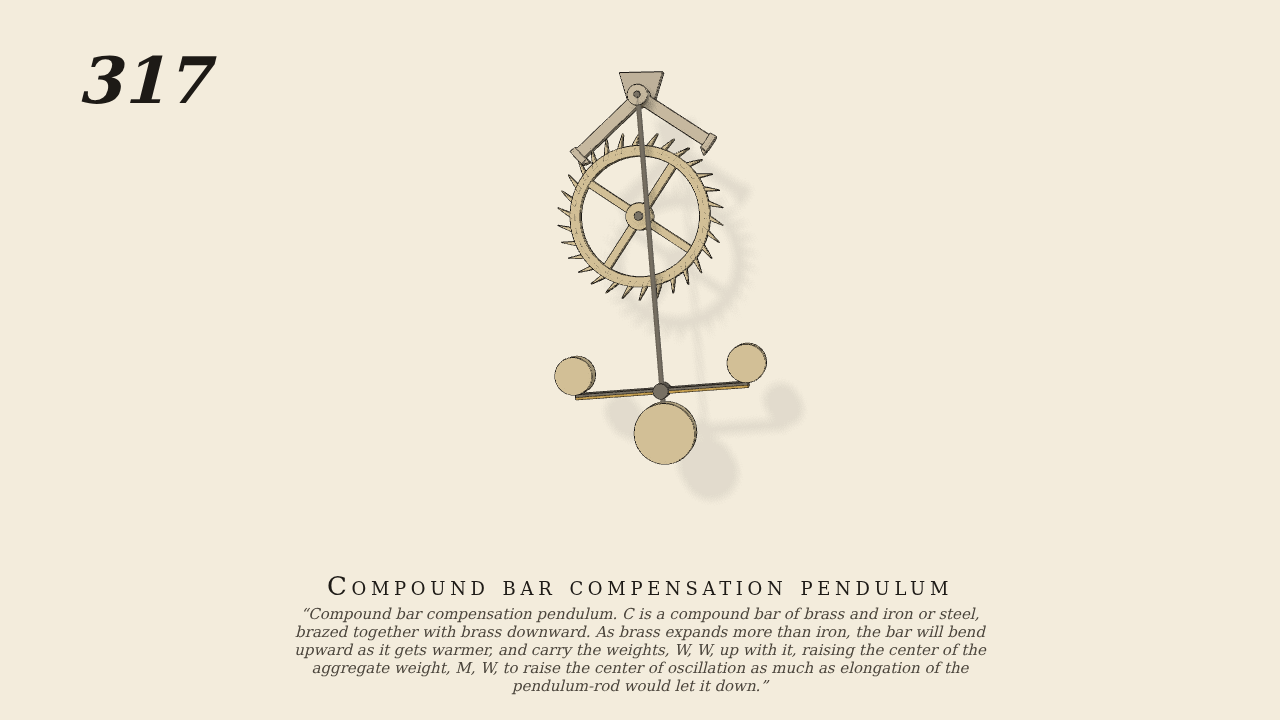
Compound bar compensation pendulum. C is a compound bar of brass and iron or steel, brazed together with brass downward. As brass expands more than iron, the bar will bend upward as it gets warmer, and carry the weights, W, W, up with it, raising the center of the aggregate weight, M, W, to raise the center of oscillation as much as elongation of the pendulum-rod would let it down.
Only the input is driven; every other part of this model moves by physics (MuJoCo), and its ratios are measured. Run it live, change its parameters, or switch the friction off to see the output stop.
- Modelled as
- Gravity is on. The clock is the dead-beat escapement of No. 303: a 30-tooth escape wheel with the pallets on the arbor C above it, and the pendulum hanging from C. The rod carries the bob M (104 g) at its end. The compound bar C is clamped across the rod 17.5 cm below C: 10.3 cm long and 0.3 cm thick, brass below and steel above. A weight W (40 g) sits on each end. Heat is not simulated. The bar's length is the one that compensates the rod. Warmed one degree, the rod lets the centre of M, W, W down 2.2×10⁻⁴ cm. Over the same degree the bar bends upward, with curvature 1.5 × (19 − 11.5)×10⁻⁶ / 0.3 cm, and lifts each weight 5.0×10⁻⁴ cm. That lifts the centre 2.2×10⁻⁴ cm, so it stays put. The only input is a constant torque on the escape wheel (the clock's weight).
- Measured
- The pendulum starts from rest, hanging straight, and the escapement starts itself. The period is 0.8679 s against the compound pendulum's 0.8669 s, from the model's own mass and inertia (bob, bar, weights and rod). The wheel goes 0.1028 rad per beat over 9 beats (0.1047 expected, half a tooth). It never turns back more than 0.084° (dead beat). The swing holds at 5.3°. The deepest contact is 0.06 mm.
- Notes
- Brown gives no sizes. The bar, the weights and the bob are choices. The bar's length is set by the expansion figures (brass 19×10⁻⁶ and steel 11.5×10⁻⁶ per degree) and the bending rule for a bar of two equal layers. Temperature itself is not in the simulation: the model is the pendulum at one temperature, and the bar is drawn straight. The compensation is the arithmetic of its proportions. The escapement and its timing are No. 303's.
Film (MP4) · Still (PNG) · Spec (YAML) · Model (MJCF)