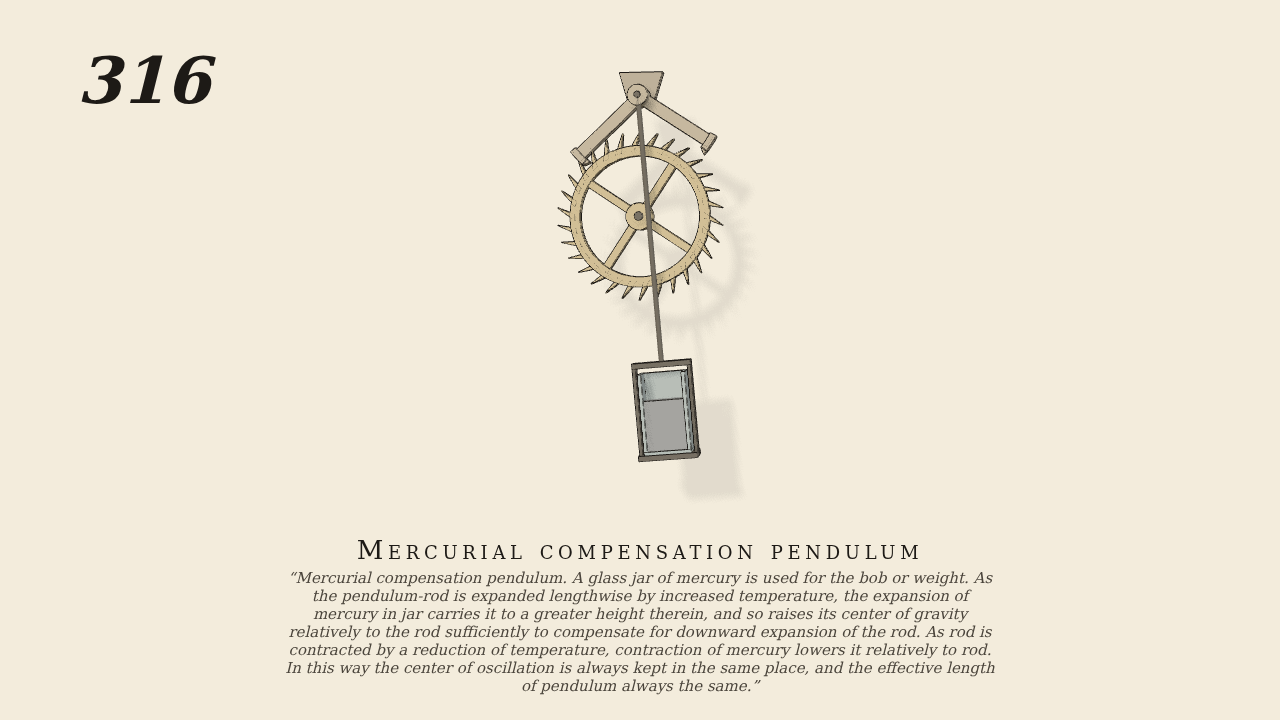
Mercurial compensation pendulum
Mercurial compensation pendulum. A glass jar of mercury is used for the bob or weight. As the pendulum-rod is expanded lengthwise by increased temperature, the expansion of mercury in jar carries it to a greater height therein, and so raises its center of gravity relatively to the rod sufficiently to compensate for downward expansion of the rod. As rod is contracted by a reduction of temperature, contraction of mercury lowers it relatively to rod. In this way the center of oscillation is always kept in the same place, and the effective length of pendulum always the same.
Only the input is driven; every other part of this model moves by physics (MuJoCo), and its ratios are measured. Run it live, change its parameters, or switch the friction off to see the output stop.
- Modelled as
- Gravity is on. The clock is the dead-beat escapement of No. 303: a 30-tooth escape wheel with the pallets on the arbor C above it, and the pendulum hanging from C. The bob is a glass jar of mercury, 3 cm deep (117 g), standing on the foot of a steel stirrup at the end of the rod. The jar's bottom is 21 cm below C. The jar is drawn without its front wall so the mercury shows. Heat is not simulated. The depth of mercury is the one that compensates: per degree, the rod lengthens 21 cm × 11.5×10⁻⁶ = 2.4×10⁻⁴ cm and lowers the jar. Over the same degree the mercury's centre rises 1.5 cm × 1.63×10⁻⁴ = 2.4×10⁻⁴ cm (mercury's expansion less the glass's), so the centre stays put. The only input is a constant torque on the escape wheel (the clock's weight).
- Measured
- The pendulum starts from rest, hanging straight, and the escapement starts itself. The period is 0.8750 s against the compound pendulum's 0.8774 s, from the model's own mass and inertia (jar, mercury, stirrup and rod). The wheel goes 0.1049 rad per beat (0.1047 expected, half a tooth). It never turns back more than 0.077° (dead beat). The swing holds at 5.2°. The deepest contact is 0.06 mm.
- Notes
- Brown gives no sizes. The jar, the depth of mercury and the rod's length are choices. The depth is set by the expansion figures above (steel 11.5×10⁻⁶ per degree; mercury's apparent expansion in glass 1.63×10⁻⁴ per degree, by volume). Temperature itself is not in the simulation: the model is the pendulum at one temperature, and the compensation is the arithmetic of its proportions. The escapement and its timing are No. 303's.
Film (MP4) · Still (PNG) · Spec (YAML) · Model (MJCF)