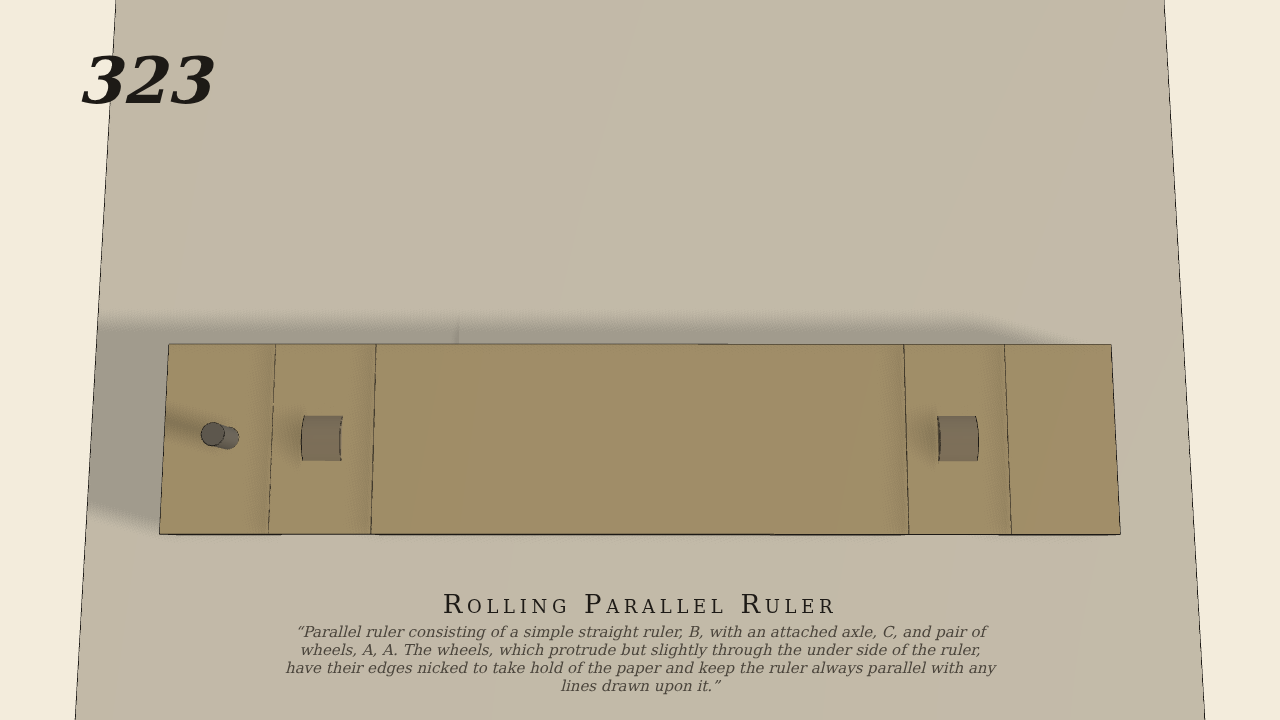
Parallel ruler consisting of a simple straight ruler, B, with an…
Parallel ruler consisting of a simple straight ruler, B, with an attached axle, C, and pair of wheels, A, A. The wheels, which protrude but slightly through the under side of the ruler, have their edges nicked to take hold of the paper and keep the ruler always parallel with any lines drawn upon it.
Only the input is driven; every other part of this model moves by physics (MuJoCo), and its ratios are measured. Run it live, change its parameters, or switch the friction off to see the output stop.
- Modelled as
- A ruler B, 30 by 6 cm, lies on a sheet of paper under gravity. An axle C runs along it in a slot, carrying a pair of wheels A, A of 1 cm radius, 20 cm apart, which stand 0.15 cm proud of the ruler's underside, so the ruler rests on the wheels alone. The nicked edges are modelled as high friction (0.9) on the paper. The only input is the hand pushing the ruler at one end, 13 cm off its middle, ±5 cm at 0.25 Hz across the paper. The hand's point is otherwise free: the ruler can slide along its length, lift, and turn about it.
- Measured
- The wheels roll without slipping: the axle turns 99.9 rad per metre of travel (100 from 1/r). Though pushed at one end only, the ruler stays parallel to where it started within 0.05° and creeps along its own length by under 0.004 cm. The deepest contact is 0.014 mm.
- Notes
- Brown gives no sizes. The ruler's size, the wheels and the stroke are choices. The nicks are modelled as friction, not as teeth. The hand's push is applied at a point that can move freely along the ruler and up, and the ruler can turn about it.
Film (MP4) · Still (PNG) · Spec (YAML) · Model (MJCF)