Lever chronometer escapement
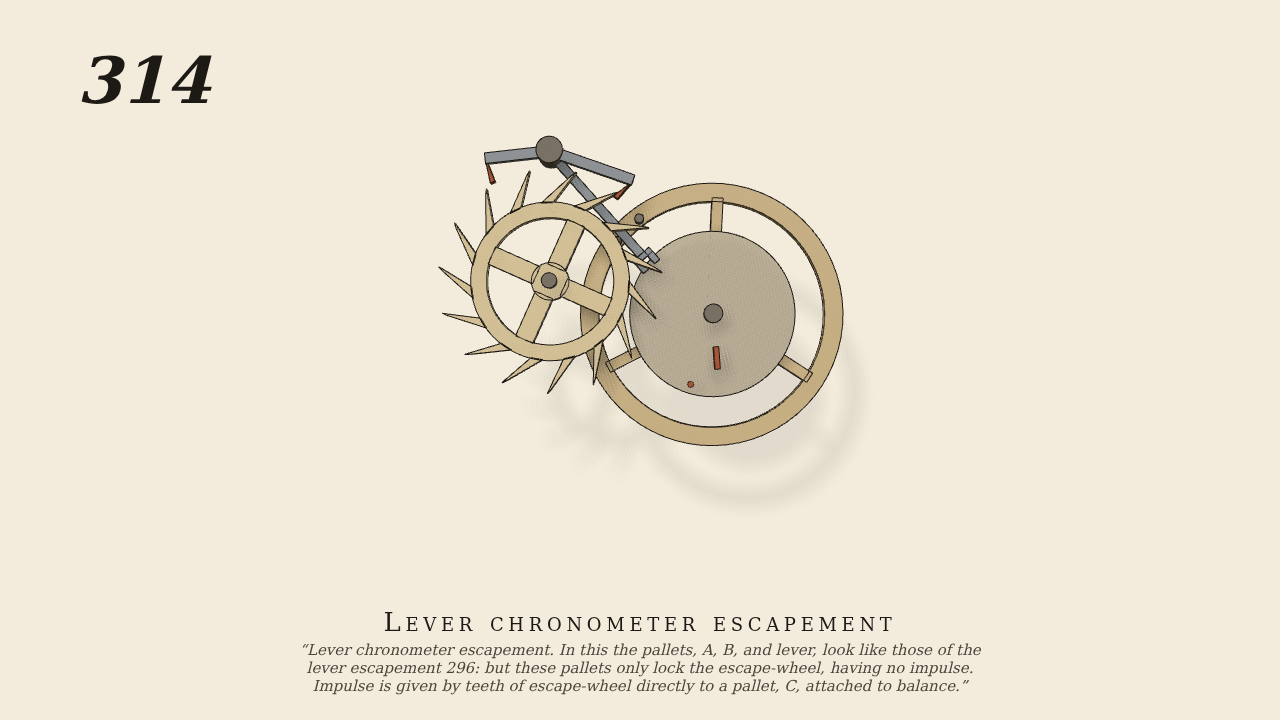
Lever chronometer escapement. In this the pallets, A, B, and lever, look like those of the lever escapement 296: but these pallets only lock the escape-wheel, having no impulse. Impulse is given by teeth of escape-wheel directly to a pallet, C, attached to balance.
Only the input is driven; every other part of this model moves by physics (MuJoCo), and its ratios are measured. Run it live, change its parameters, or switch the friction off to see the output stop.
- Modelled as
- A plan of the watch, so gravity is off. The 15-toothed escape-wheel is urged clockwise by a constant torque (the mainspring). The anchor above it carries the pallets A and B and the lever, as in No. 296, but each pallet is only a narrow locking stone with no impulse face. Its locking face leans so the resting tooth draws the lever against its banking pin. The pallets are set unequally: the wheel goes 20° when A lets go and 4° when B does, one tooth in all. The lever runs down to the right to its notch, and the balance's arbor stands beyond the notch, close to the wheel's right side. Its disk carries the unlocking pin, and on the arbor is the pallet C, which reaches just inside the teeth's points. Turning counterclockwise, the pin unlocks A as C comes up to the wheel. The next tooth overtakes C and drives it on (the impulse), and B locks the wheel. Coming back, C passes the locked wheel through a gap between two teeth, and then the pin unlocks B for the short 4° drop. The only input is the torque on the wheel.
- Measured
- The balance is let go 2 rad from its rest and runs on by itself. The wheel goes 0.2095 rad per beat over 16 beats (0.2094 expected, one tooth per vibration pair). The swing holds at 117.6° (115.3° in the last third). The period is 1.0186 s against the balance on its spring alone (1.0187 s). It also runs with 1.5 times the torque (swing 125°). With 0.7 times the torque it still goes but slowly loses swing (111° falling to 106° over 12 s). The wheel turns back at most 1.0° (the draw's recoil at unlocking). The deepest contact is 0.28 mm.
- Notes
- Brown gives no sizes. The tooth count, the stones' width, their unequal setting, the place of the balance and the reach of C are choices. The unequal setting is what lets C pass the locked wheel on the return. With equal half-tooth drops, a tooth would stand in C's path. The balance spring is a joint spring and is not drawn. The balance's rim is drawn behind the wheel. A chronometer is not self-starting, so the balance is set going by hand: it starts turned 2 rad from its spring's free position.
Film (MP4) · Still (PNG) · Spec (YAML) · Model (MJCF)