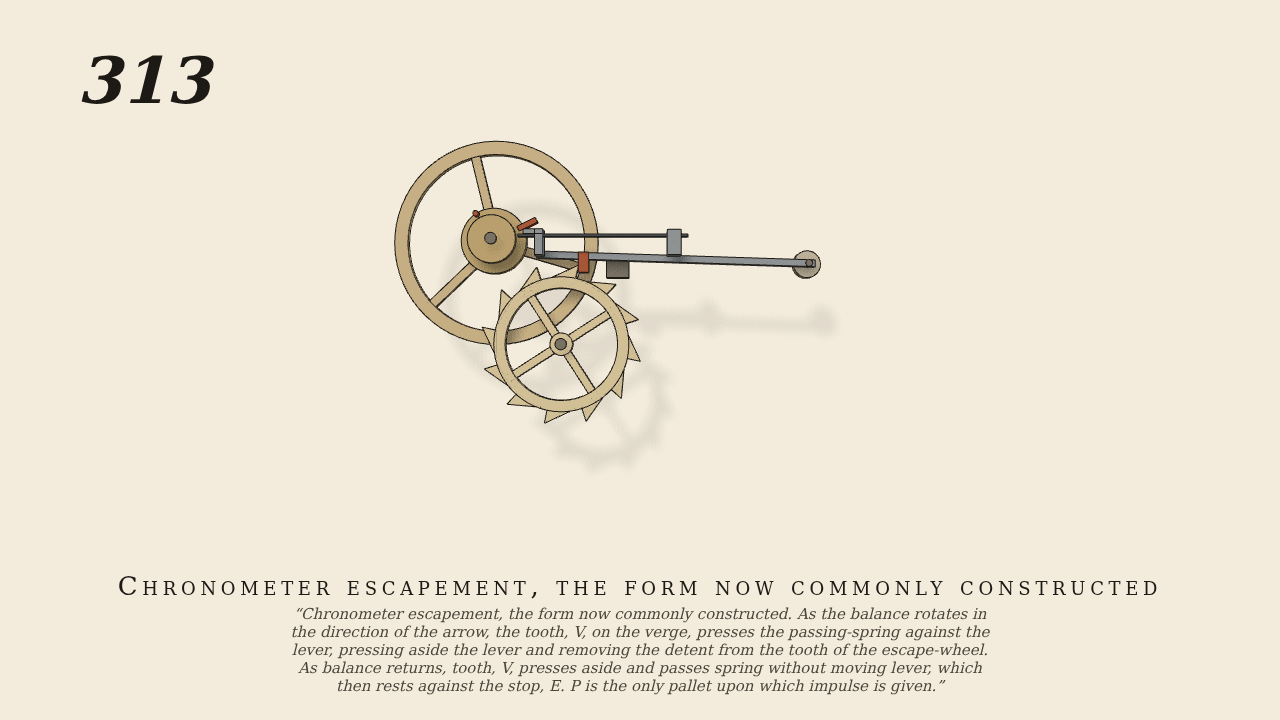
Chronometer escapement, the form now commonly constructed
Chronometer escapement, the form now commonly constructed. As the balance rotates in the direction of the arrow, the tooth, V, on the verge, presses the passing-spring against the lever, pressing aside the lever and removing the detent from the tooth of the escape-wheel. As balance returns, tooth, V, presses aside and passes spring without moving lever, which then rests against the stop, E. P is the only pallet upon which impulse is given.
Only the input is driven; every other part of this model moves by physics (MuJoCo), and its ratios are measured. Run it live, change its parameters, or switch the friction off to see the output stop.
- Modelled as
- A plan of the watch, so gravity is off. The balance turns on its verge, held by its balance spring (a joint spring) for a 1.0026 s vibration pair. Its rim is behind the plate. In front the verge carries a small roller with the impulse pallet P and, in front of that, the discharging tooth V. The 12-toothed escape-wheel is urged clockwise by a constant torque (the mainspring). A tooth rests on the detent, the locking stone under the lever. The lever turns on a pivot and a light spring holds it down against the stop E. On the lever the lighter passing-spring runs out under V's path and lies up against the lever's horn at its end; it is a hinge on the lever whose upper stop is the horn. Swinging in the direction of Brown's arrow (counterclockwise here), V lifts the passing-spring, which bears on the horn and presses the lever aside. The detent leaves the tooth, the wheel escapes, and at once the next tooth strikes P and pushes the balance on; the lever falls back against E and the detent arrests the following tooth. Swinging back, V presses the passing-spring down and passes it without moving the lever, which rests against E. P is the only pallet that takes impulse. The only input is the torque on the wheel.
- Measured
- The balance is let go 2.2 rad from its rest and runs on by itself. The wheel goes exactly one tooth each vibration pair (0.2618 rad a beat over 16 beats). The swing grows to 139.5° and holds (135.8° in the first third of the window). The period is 1.0060 s against the free balance's 1.0026 s (0.3% slow): the balance is touched only while V passes the spring and the tooth gives the impulse. It also runs with 0.7 times the torque (swing 122°) and 1.5 times (165°). The wheel bounces back at most 0.7° when the detent catches it. The deepest contact is 0.33 mm.
- Notes
- Brown gives no sizes. The working faces, springs and timing are those of No. 291; what differs is that the detent is a lever on a pivot, held by a light spring against the stop E, instead of a spring blade from a foot, so the two run alike. The lever and the passing-spring are stiff pieces on sprung hinges, not bending blades. The balance spring is a joint spring and is not drawn. A chronometer is not self-starting, so the balance is set going by hand: it starts turned 2.2 rad from its spring's free position.
Film (MP4) · Still (PNG) · Spec (YAML) · Model (MJCF)