Bloxam’s gravity escapement
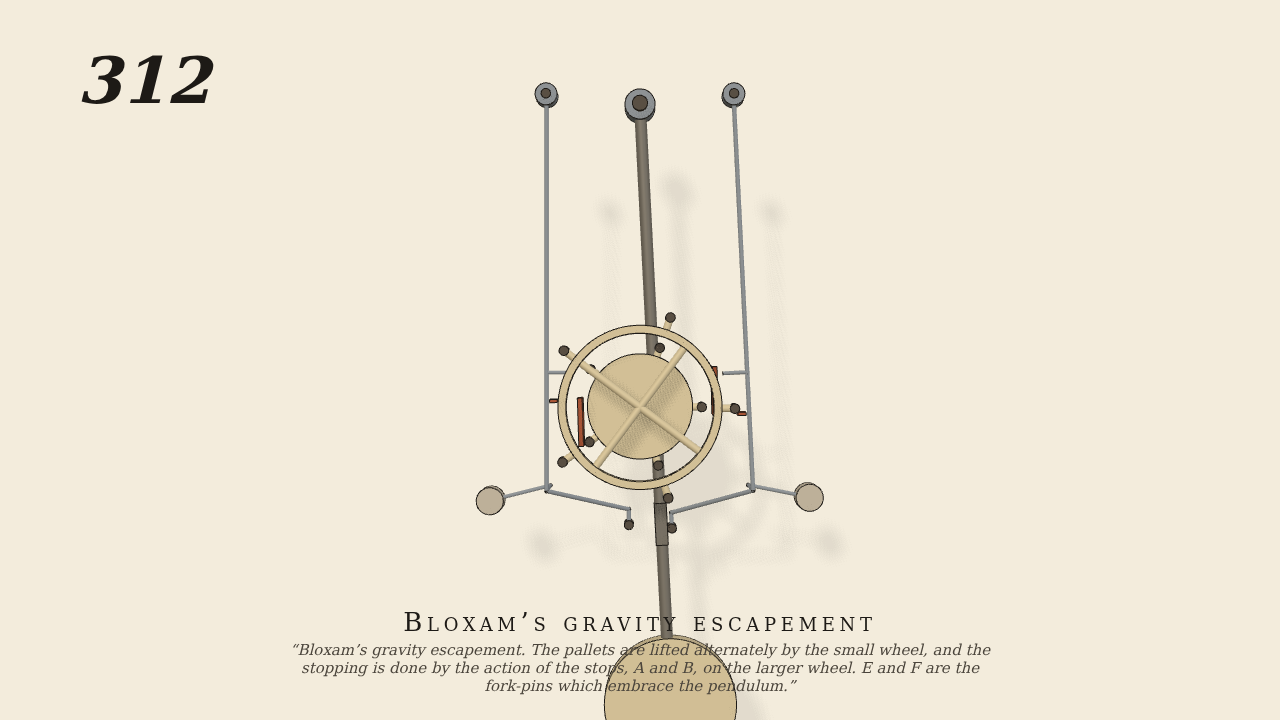
Bloxam’s gravity escapement. The pallets are lifted alternately by the small wheel, and the stopping is done by the action of the stops, A and B, on the larger wheel. E and F are the fork-pins which embrace the pendulum.
Only the input is driven; every other part of this model moves by physics (MuJoCo), and its ratios are measured. Run it live, change its parameters, or switch the friction off to see the output stop.
- Modelled as
- Gravity on. The escape-wheel is a small lifting wheel and a larger locking wheel on one arbor, each with five round-tipped teeth (at radius 2 and 3), and a constant torque turns it clockwise (the weight). The pendulum hangs from a pivot 10 above the wheel's axis. The two pallets hang from arbors of their own, 3 either side of the pendulum's pivot and at the same height. Each pallet carries a weight and a fork-pin (E on the left, F on the right), and the fork-pins lie against the pendulum rod 4 below the wheel's axis, embracing it. A banking stops each pallet when it hangs against the rod. Each pallet has an upright lifting face in the small wheel's path, and a short stop (A on the left, B on the right) in the large wheel's path, right under its arbor. A tooth of the small wheel pushes the face out and lifts the pallet's weight until a tooth of the large wheel lands on the stop and the wheel is locked. The stop is struck nearly through the arbor, so the locked tooth does not push the pallet. The pendulum swinging that way takes up the lifted pallet by its fork-pin and raises it a little further, the stop slides from under the tooth, and the wheel goes a tenth of a turn until the other pallet's stop catches the next tooth, the small wheel having lifted that pallet in turn. The pendulum comes back with the first pallet resting on it, and the pallet's weight falls further than the pendulum lifted it, down to its banking: that is the impulse. The pendulum is drawn 4° aside to the right at the start, with the right pallet resting on its rod, and the only input is the torque on the wheel.
- Measured
- The wheel goes a tenth of a turn per beat (0.6283 rad; 0.6283 expected) over 15 beats, never going faster. The pendulum's period is 0.881 s against 0.899 s for the free compound pendulum, 2.0% fast. Its swing holds at about 4.0° either side (3.98° in the first third, 3.96° in the last). With 0.7 times the torque it swings 3.96° and with 1.5 times 4.00°, nearly the same, as a gravity escapement should. The wheel turns back at most 0.7° (allowed 2.3°). The deepest contact after the first second is 0.36 mm.
- Notes
- Brown gives no sizes. The pallets' weights bear on the rod for part of each swing, which stiffens the pendulum a little and makes it run 2.0% fast; the bob is made heavy so this stays small. With twice the torque the teeth throw the pallets off and the wheel runs through. The swing is measured about the pendulum's hanging position, 4° from where it starts.
Film (MP4) · Still (PNG) · Spec (YAML) · Model (MJCF)