By a vibratory motion of the handle, motion is communicated by the…
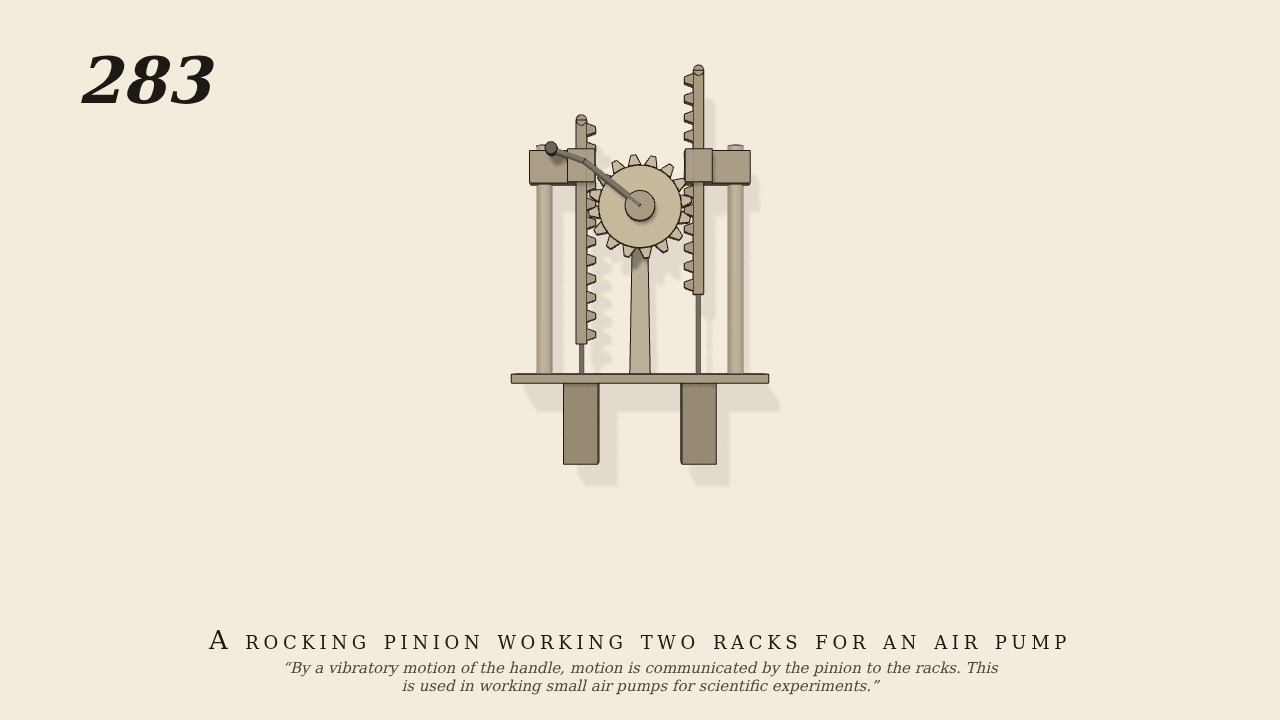
By a vibratory motion of the handle, motion is communicated by the pinion to the racks. This is used in working small air pumps for scientific experiments.
Only the input is driven; every other part of this model moves by physics (MuJoCo), and its ratios are measured. Run it live, change its parameters, or switch the friction off to see the output stop.
- Modelled as
- A pinion (16 teeth, module 0.8, pitch radius 6.4 cm) on a fixed shaft is the one driven joint: its handle is rocked 0.8 rad either way at 0.35 Hz. It meshes by real contact with two upright racks, one on each side, which slide in guides on the frame. Each rack carries a piston-rod and a piston working in an air-pump barrel below the base. Gravity is on. The two racks are equal, so their weights balance through the pinion. The pumps' resistance is the slides' damping, and stops 6.32 cm from the middle stand for the pistons bottoming in their barrels.
- Measured
- The left rack follows the pinion at +6.40 cm per radian and the right rack at −6.40 cm per radian (r² 0.9999 each). Each rack travels 5.1 cm either way, the same in the first and last thirds of the run. The deepest contact is 0.02 mm.
- Notes
- Brown gives no sizes, and the barrels' valves are not modelled. Turning the pinion clockwise raises the left rack and lowers the right one, so one pump draws while the other delivers.
Film (MP4) · Still (PNG) · Spec (YAML) · Model (MJCF)