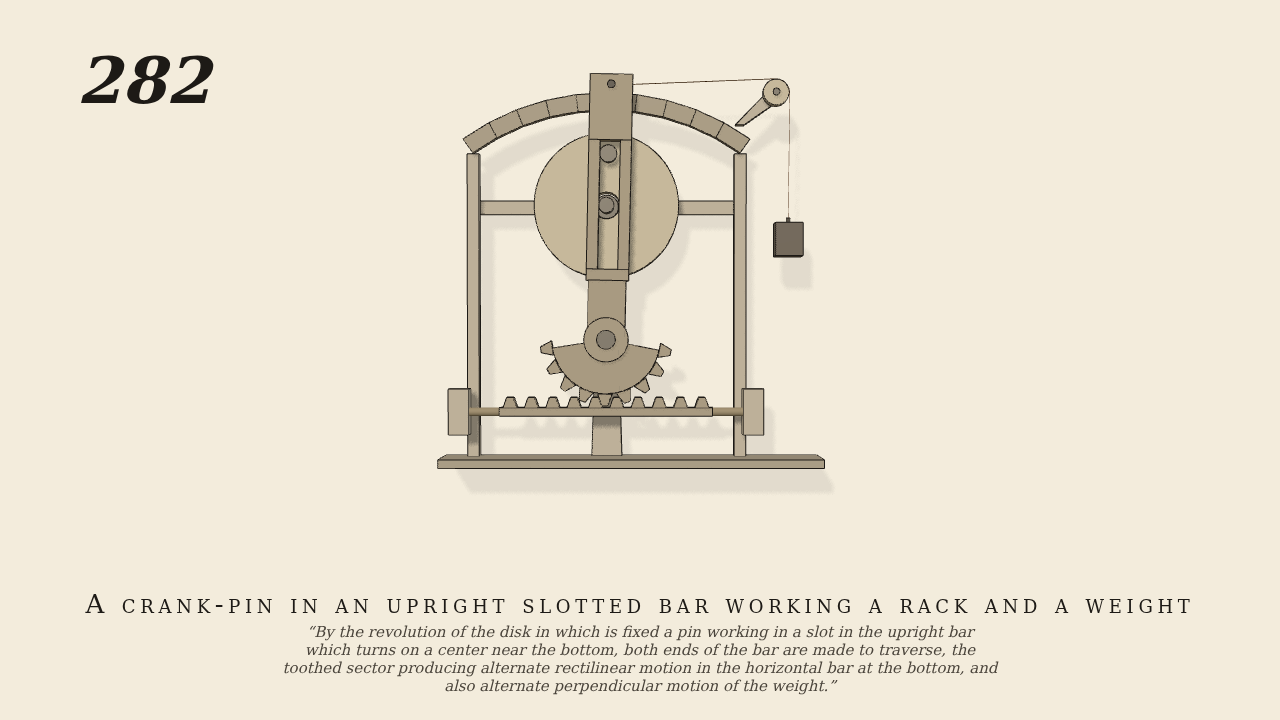
By the revolution of the disk in which is fixed a pin working in a…
By the revolution of the disk in which is fixed a pin working in a slot in the upright bar which turns on a center near the bottom, both ends of the bar are made to traverse, the toothed sector producing alternate rectilinear motion in the horizontal bar at the bottom, and also alternate perpendicular motion of the weight.
Only the input is driven; every other part of this model moves by physics (MuJoCo), and its ratios are measured. Run it live, change its parameters, or switch the friction off to see the output stop.
- Modelled as
- A disk (radius 8.6 cm) is the one driven joint, at 12 turns a minute, on a shaft 16 cm above the centre of an upright bar. A crank-pin 6 cm from the disk's centre works in a slot in the bar by real contact, so the bar swings asin(6/16) = 0.384 rad either way. Below its centre the bar carries a toothed sector (module 0.8, pitch radius 7.2 cm, as No. 131) that meshes with a rack along the bottom. The bar's top end, 30 cm up, draws a cord over a pulley at the right, from which a 0.5 kg weight hangs. Gravity is on. The weight keeps the cord taut and the pin on one wall of the slot. A curved guide spans the top of the frame, as in the plate (drawn only).
- Measured
- The bar swings 22.0 degrees either way. The rack follows it at 7.63 cm per radian (r² 0.9993) and travels from −3.01 to +2.83 cm. The weight follows at −29.1 cm per radian (r² 0.9997), rising about 11 cm as the head swings left and falling as far when it swings right. The deepest contact is 0.02 mm.
- Notes
- Brown gives no sizes. The straight-flanked sector teeth bear a little outside the 7.2 cm pitch circle, so the rack moves 7.6 cm per radian rather than 7.2. The pin has 0.2 mm of play in the slot, so the bar leans 0.02 rad under the cord's pull before the disk starts.
Film (MP4) · Still (PNG) · Spec (YAML) · Model (MJCF)