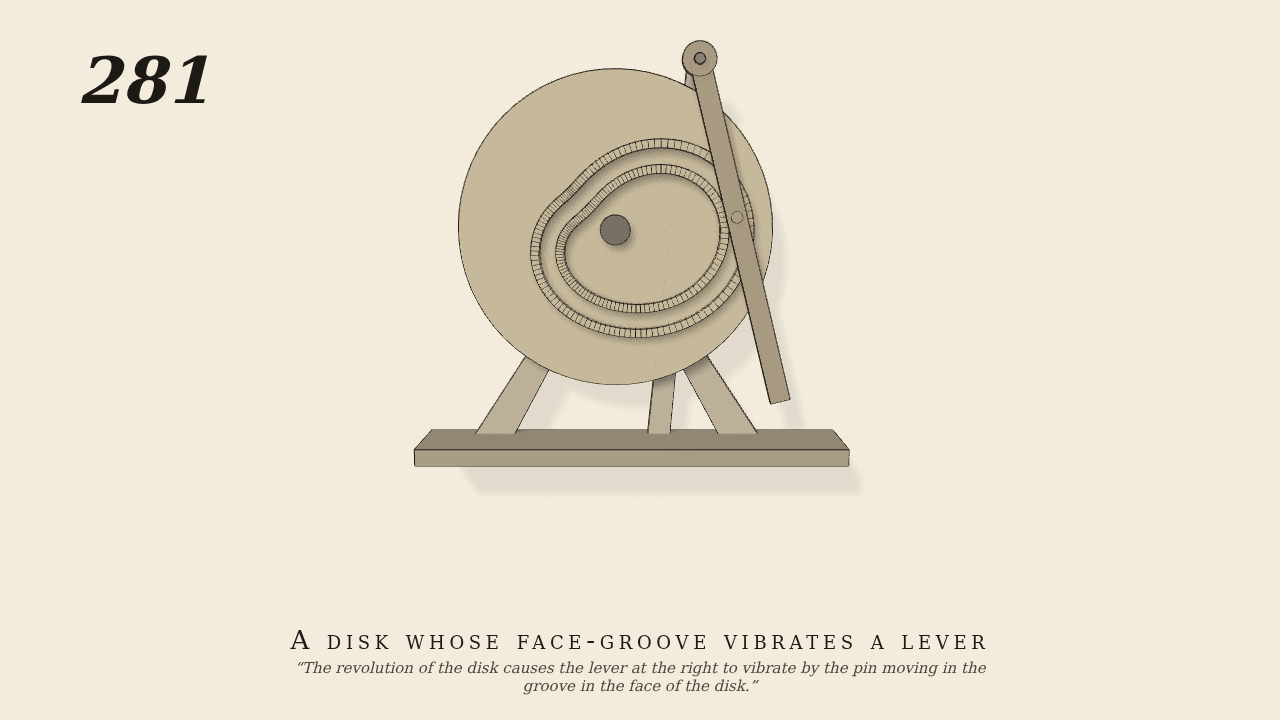
The revolution of the disk causes the lever at the right to…
The revolution of the disk causes the lever at the right to vibrate by the pin moving in the groove in the face of the disk.
Only the input is driven; every other part of this model moves by physics (MuJoCo), and its ratios are measured. Run it live, change its parameters, or switch the friction off to see the output stop.
- Modelled as
- A disk (radius 9.6 cm) is the one driven joint, at 20 turns a minute. An endless groove 1.02 cm wide is cut in its face, with walls that make real contact. A lever hangs from a fulcrum above the disk on the right. A pin 9.5 cm down the lever runs in the groove. The groove is the pin's path in the disk's own frame for the lever angle φ = 0.25 (sin t + 0.35 sin 2t)/1.175. That makes the lever swing 0.25 rad either way once a turn, faster one way than the other, and the groove pushes the pin both ways without any spring.
- Measured
- The lever follows the groove. Around the disk angle 0 it turns 0.3521 rad per radian of disk (ideal 0.3527, r² 0.9999). From 200° to 260° it turns −0.1518 rad per radian (ideal −0.1520). It swings between −0.249 and 0.249 rad. The deepest contact is 0.05 mm.
- Notes
- Brown gives no sizes, and his groove is a lopsided heart. Here a second harmonic gives the same quick-and-slow swing. The pin has 0.1 mm of play on each side of the groove, so the lever's weight moves the pin from one wall to the other as the lever passes the middle of its swing.
Film (MP4) · Still (PNG) · Spec (YAML) · Model (MJCF)