A mode of working a windlass
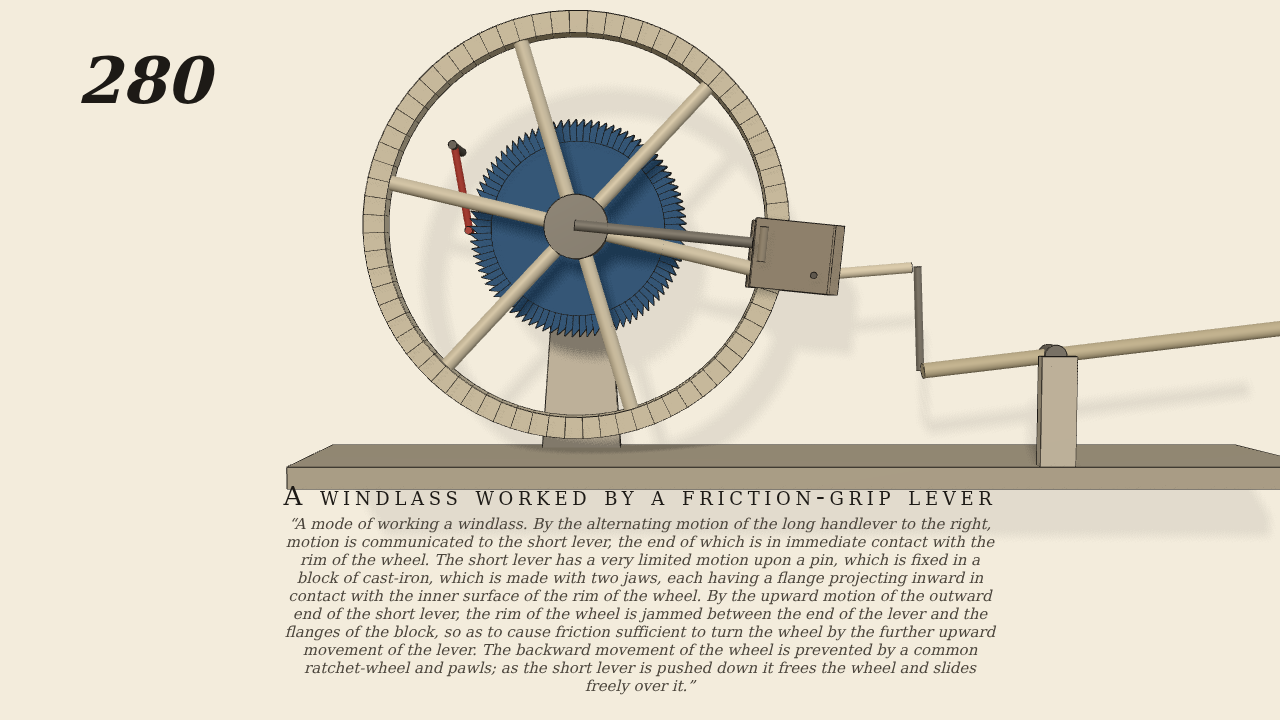
A mode of working a windlass. By the alternating motion of the long handlever to the right, motion is communicated to the short lever, the end of which is in immediate contact with the rim of the wheel. The short lever has a very limited motion upon a pin, which is fixed in a block of cast-iron, which is made with two jaws, each having a flange projecting inward in contact with the inner surface of the rim of the wheel. By the upward motion of the outward end of the short lever, the rim of the wheel is jammed between the end of the lever and the flanges of the block, so as to cause friction sufficient to turn the wheel by the further upward movement of the lever. The backward movement of the wheel is prevented by a common ratchet-wheel and pawls; as the short lever is pushed down it frees the wheel and slides freely over it.
Only the input is driven; every other part of this model moves by physics (MuJoCo), and its ratios are measured. Run it live, change its parameters, or switch the friction off to see the output stop.
- Modelled as
- The windlass wheel (rim 9 to 10 cm) turns on a fixed axle against friction in its bearings. Its ratchet-wheel has 90 teeth, and a spring pawl works in it. A cast-iron block straddles the rim at the right. An arm on the axle keeps the block to the rim but leaves it free to slide round the rim and, a little, in and out. The block's jaws carry a flange inside the rim's inner face and a pin on which the short lever rocks. The lever's end bears on the rim's outer face. The long hand-lever, pivoted on the frame to the right, is the one driven joint, swung ±0.2 rad once a second. A link carries its motion to the short lever's outward end.
- Measured
- On each upstroke the lever's end and the flange pinch the rim, and the wheel is turned by friction alone. Over 13 beats from 1 s on, the windlass advances −0.0693 rad per beat of the hand-lever (0.905 rad in all). On the downstrokes the grip lets go and the block slides back over the rim, while the pawl holds the wheel: it runs back 0.011 rad at most. The deepest contact after 0.5 s is 0.13 mm; there is 2.4 mm at the start, while the pawl and grip settle.
- Notes
- Brown gives no sizes. One flange bar stands for the two jaws' flanges, and a single pawl for his pawls. The hand-lever's swing is a velocity drive, so its mean drifts a little under load.
Film (MP4) · Still (PNG) · Spec (YAML) · Model (MJCF)