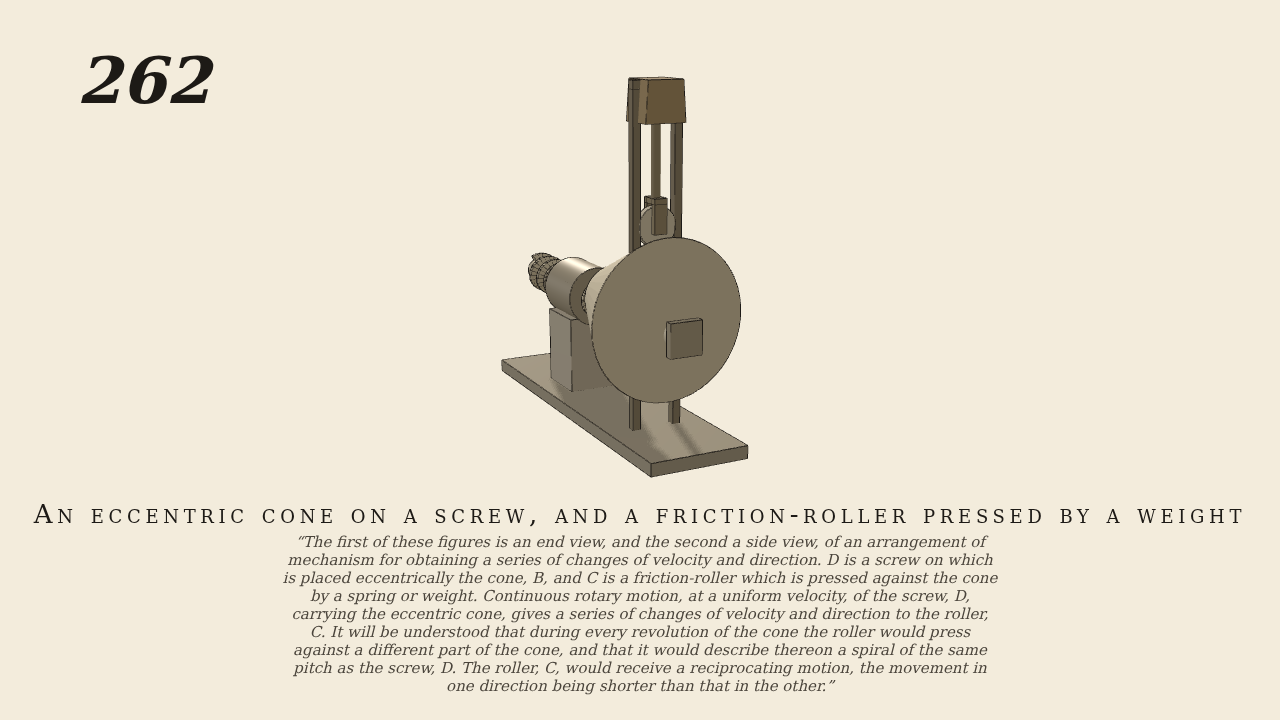
The first of these figures is an end view, and the second a side…
262-263. The first of these figures is an end view, and the second a side view, of an arrangement of mechanism for obtaining a series of changes of velocity and direction. D is a screw on which is placed eccentrically the cone, B, and C is a friction-roller which is pressed against the cone by a spring or weight. Continuous rotary motion, at a uniform velocity, of the screw, D, carrying the eccentric cone, gives a series of changes of velocity and direction to the roller, C. It will be understood that during every revolution of the cone the roller would press against a different part of the cone, and that it would describe thereon a spiral of the same pitch as the screw, D. The roller, C, would receive a reciprocating motion, the movement in one direction being shorter than that in the other.
Only the input is driven; every other part of this model moves by physics (MuJoCo), and its ratios are measured. Run it live, change its parameters, or switch the friction off to see the output stop.
- Modelled as
- End view of Brown's pair, gravity on, shafts level. The screw D (pitch 1.6 cm, 20 turns a minute, the one driven joint) works in a fixed two-turn nut, so it travels along its axis 1.6 cm a turn, free in its carriage. The cone B, fast on D, runs from radius 2.5 to 6.1 cm over 9 cm, its axis 1.2 cm off D's. The friction-roller C (radius 1.5 cm), over D's axis in a vertical slide, is pressed on the cone by a 1 kg weight. Each turn the eccentricity lifts C and lets it fall 2.4 cm, while the travelling cone brings ever wider circles under it, so C traces a spiral of the screw's pitch and rises further than it falls. Only the threads and the cone's contact on C touch.
- Measured
- The screw travels -0.0025 m per radian of D (ideal -0.0025, r2 1.000). C follows the cone at 0.0131 m/rad at its fastest rise and -0.0110 at its fastest fall (ideal 0.0132 and -0.0111, r2 0.999), and ranges -0.94 to 2.44 cm about its start (ideal -0.92 to 2.45): strokes +2.73 and -2.09 cm. C spins by friction at 2.15 to 4.28 of D in slices (ideal 2.24 to 4.49 at the extremes). The deepest contact is 0.03 mm.
- Notes
- Brown gives no sizes; the shared text describes both figures, built here as the same machine: this end view with a weight, No. 263 the side view with a spring. The roller is a plain cylinder whose corner bears on the 22 degree cone; the cone slides under it along its axis as the screw travels. The roller's pin carries almost no damping, so friction alone turns it without creep.
Film (MP4) · Still (PNG) · Spec (YAML) · Model (MJCF)