A combination movement, in which the weight, W, moves vertically…
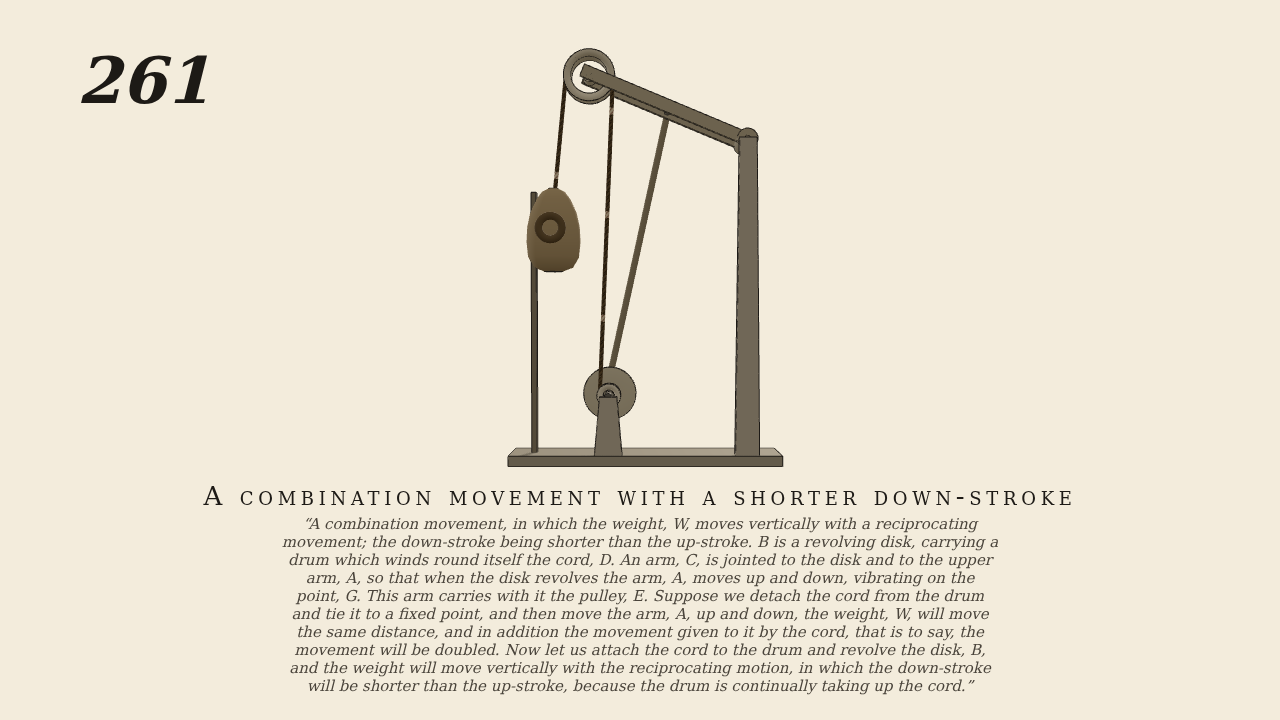
A combination movement, in which the weight, W, moves vertically with a reciprocating movement; the down-stroke being shorter than the up-stroke. B is a revolving disk, carrying a drum which winds round itself the cord, D. An arm, C, is jointed to the disk and to the upper arm, A, so that when the disk revolves the arm, A, moves up and down, vibrating on the point, G. This arm carries with it the pulley, E. Suppose we detach the cord from the drum and tie it to a fixed point, and then move the arm, A, up and down, the weight, W, will move the same distance, and in addition the movement given to it by the cord, that is to say, the movement will be doubled. Now let us attach the cord to the drum and revolve the disk, B, and the weight will move vertically with the reciprocating motion, in which the down-stroke will be shorter than the up-stroke, because the drum is continually taking up the cord.
Only the input is driven; every other part of this model moves by physics (MuJoCo), and its ratios are measured. Run it live, change its parameters, or switch the friction off to see the output stop.
- Modelled as
- Front view, gravity on. The disk B (12 turns a minute, the one driven joint) carries a crank pin 2 cm from its centre and a drum of radius 0.8 cm on which the cord D (0.5 cm thick, 80 links) is lashed. The rod C, pinned to the crank pin and to the arm A 10 cm from its pivot G, rocks A, which carries the pulley E (radius 2.5 cm) 20 cm from G. D runs plumb up from the drum, over E and down to the weight W (0.5 kg) in its guide. W moves twice what E moves, plus the cord the drum takes up (1.05 cm a radian), so its up-strokes are longer than its down-strokes. Only the cord's contact on the drum and on E carries W.
- Measured
- W follows B at 0.0912 m/rad mid up-stroke and -0.0680 mid down-stroke (ideal 0.0889 and -0.0679, r2 0.999), and at 0.0112 at the arm's dead point, where only the drum's take-up moves it (ideal 0.0105). Over the run W rises 19.0 cm, falls 12.4 and rises again (ideal +18.7, -12.5). Over one turn of B it gains 0.0108 m/rad. The deepest contact is 0.9 mm, between the cord and its sheaves.
- Notes
- Brown gives no sizes. The disk rides 4 cm in front of the drum so its rim stays clear of the cord, and C and A's pin sit in front of it. B is held near its set speed by a stiff velocity servo; it starts from rest and runs 23 ms behind its nominal angle, which the check windows allow for. The dead-point slope is read over a 0.25 s window, where the arm's own swing still adds a little.
Film (MP4) · Still (PNG) · Spec (YAML) · Model (MJCF)