Releasing-hook, used in pile-driving machines
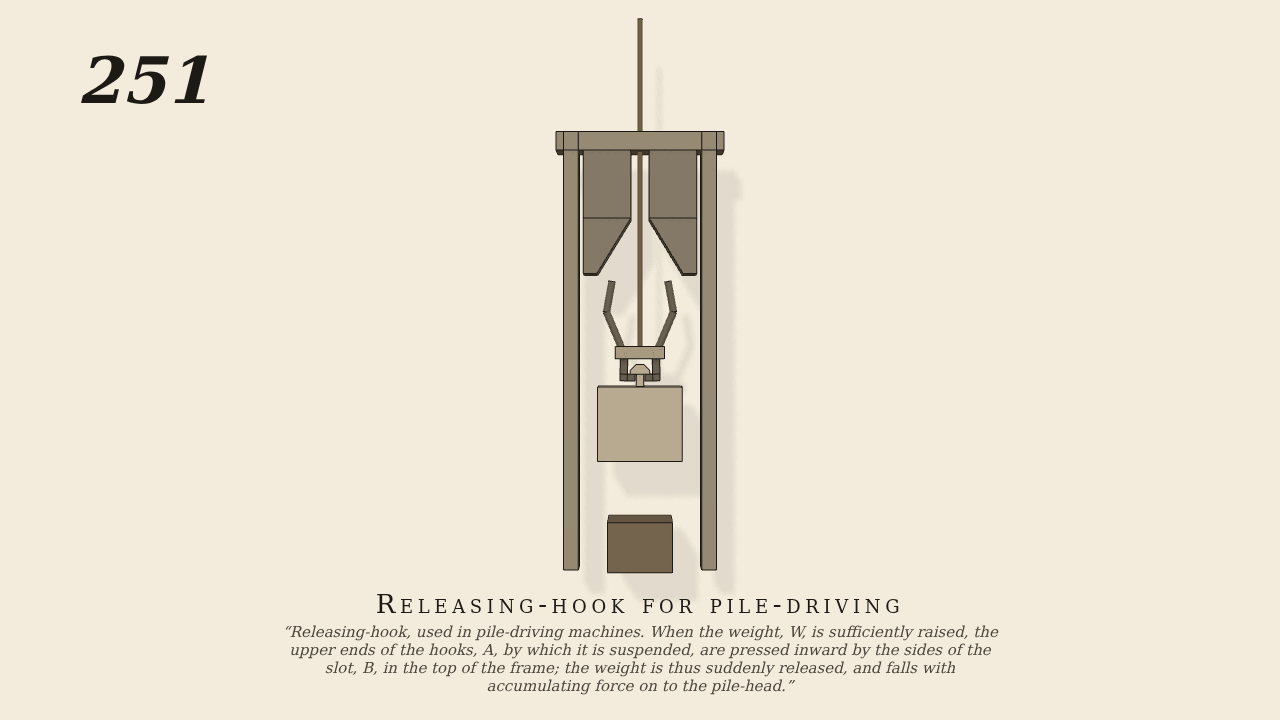
Releasing-hook, used in pile-driving machines. When the weight, W, is sufficiently raised, the upper ends of the hooks, A, by which it is suspended, are pressed inward by the sides of the slot, B, in the top of the frame; the weight is thus suddenly released, and falls with accumulating force on to the pile-head.
Only the input is driven; every other part of this model moves by physics (MuJoCo), and its ratios are measured. Run it live, change its parameters, or switch the friction off to see the output stop.
- Modelled as
- Side view. The rope draws the crosshead up its guide at 2 cm/s (the one driven joint, force limited to 80 N). The two hooks A are pinned to it, held in against W's neck by a light spring. Their lips are under the knob on the weight W (1 kg), which stands on the pile-head on its own guide. The slot B in the frame's top has sides that close in from 7 to 1.5 cm apart over 4.5 cm of height.
- Measured
- W hangs by the hooks and goes up with the crosshead (ratio 1.0000 over 0.5 to 3.5 s). From 3.6 s the hooks' upper ends ride in the slot's sides and are pressed inward. At 8.5 cm the lips swing out from under the knob (about 0.25 rad) and W falls back on the pile-head. It lies there from 5.0 s on (-0.010 cm), with the hooks held open at 0.32 to 0.43 rad. The deepest contact is 0.11 mm.
- Notes
- Brown gives no sizes. One lift is shown; the run ends before the crosshead reaches the top of the slot. The spring stands for the hooks' own weight keeping them shut.
Film (MP4) · Still (PNG) · Spec (YAML) · Model (MJCF)