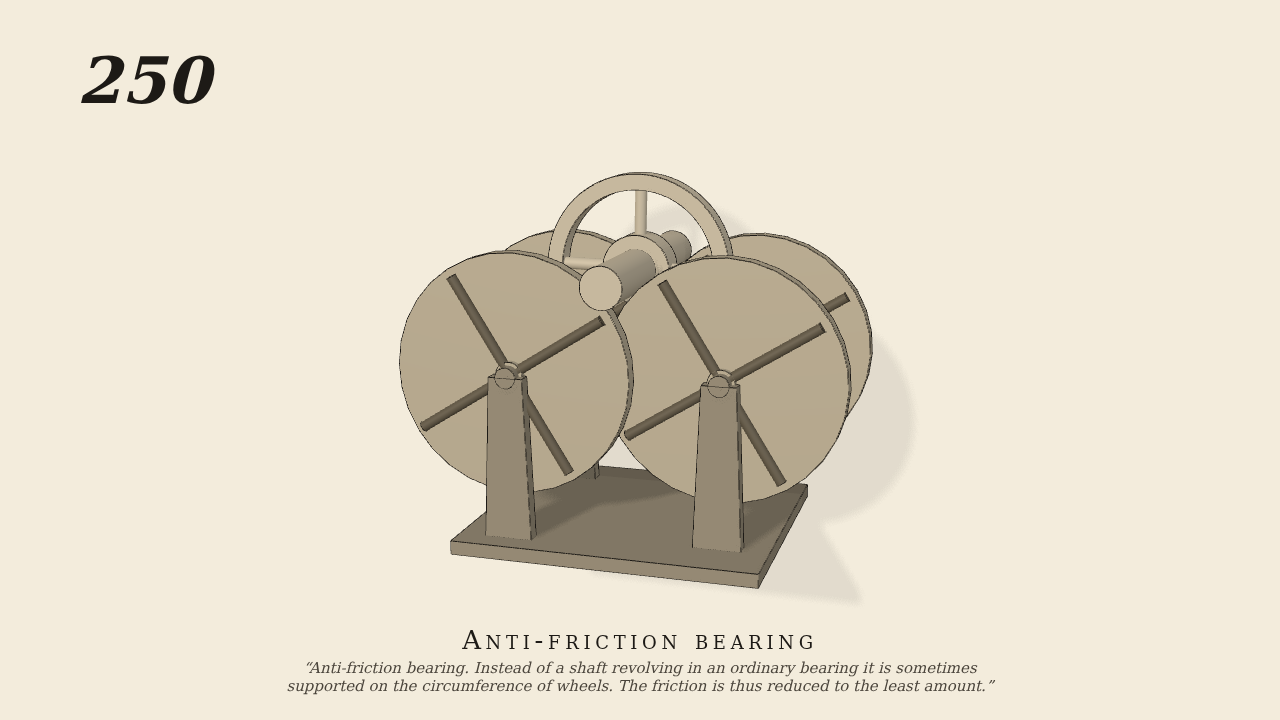
Anti-friction bearing
Anti-friction bearing. Instead of a shaft revolving in an ordinary bearing it is sometimes supported on the circumference of wheels. The friction is thus reduced to the least amount.
Only the input is driven; every other part of this model moves by physics (MuJoCo), and its ratios are measured. Run it live, change its parameters, or switch the friction off to see the output stop.
- Modelled as
- The shaft (journal radius 1.2) has no bearing of its own. At each end it lies by its weight in the crotch of two overlapping friction wheels (radius 7, centres 12 apart, in planes side by side as drawn), four wheels in all, each free on its own fixed axle. The shaft rides free on two slides (across and up/down), so only the wheels' rims carry it. The shaft turns at 30 rpm (the one driven joint, torque limited to 2 N·m). The wheels are turned only by rolling contact with it.
- Measured
- All four wheels roll the other way at r/R of the shaft's speed: -0.1714 against -0.1714 (slip -0.01%). The shaft stays in the crotch, within 0.001 cm across and up/down. The deepest contact is 0.01 mm.
- Notes
- Brown gives no sizes. The pulley on the shaft is drawn only. The rims are smooth cylinders rolling on the journal.
Film (MP4) · Still (PNG) · Spec (YAML) · Model (MJCF)