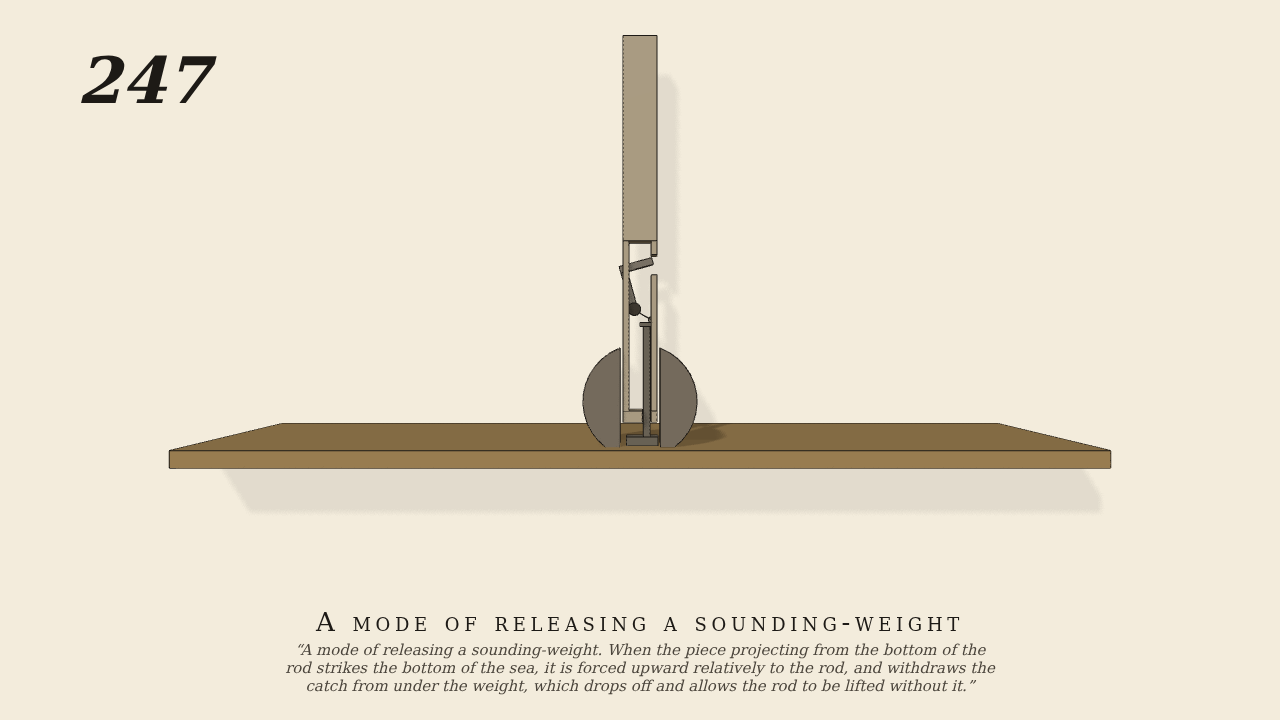
A mode of releasing a sounding-weight
A mode of releasing a sounding-weight. When the piece projecting from the bottom of the rod strikes the bottom of the sea, it is forced upward relatively to the rod, and withdraws the catch from under the weight, which drops off and allows the rod to be lifted without it.
Only the input is driven; every other part of this model moves by physics (MuJoCo), and its ratios are measured. Run it live, change its parameters, or switch the friction off to see the output stop.
- Modelled as
- The rod is shown in section. The line lowers it 6.2 cm and raises it back past its start, a slow positioned swing (the one driven joint). The weight is a 2 kg ball bored for the rod and flat underneath. It rides on the catch's tooth, which comes out through a window in the rod's side. The catch is hinged in the rod at (-0.5, 10), and the weight's load holds it out against a stop. The feeler slides in the rod's foot, held down by a light spring, and its foot projects 0.8 cm below the rod. The feeler's head sits 0.1 cm under the catch's tail. The sea bottom is fixed at z -7.6. The weight's guide is damped (the water).
- Measured
- On the way down the weight goes with the rod exactly (slope 1.0000, r² 1.0000) and the catch stays shut (-0.001 rad). At 1.4 s the feeler strikes the bottom and is forced up 0.2 to 0.47 cm relatively to the rod. It turns the catch up to 0.27 rad and the tooth withdraws. The weight drops off and settles on the bottom at 21.6 cm by 2.6 s. The rod is raised without it, to 6.6 cm above its start. The deepest contact is 0.23 mm.
- Notes
- Brown gives no sizes. The tooth reaches 0.4 cm under the weight's flat bottom, so a 0.1 rad turn of the catch frees it. The weight's damping stands for the water and only slows the drop. The line's velocity servo is stiff (kv 20000) because the swing's target speed is small when the feeler strikes.
Film (MP4) · Still (PNG) · Spec (YAML) · Model (MJCF)