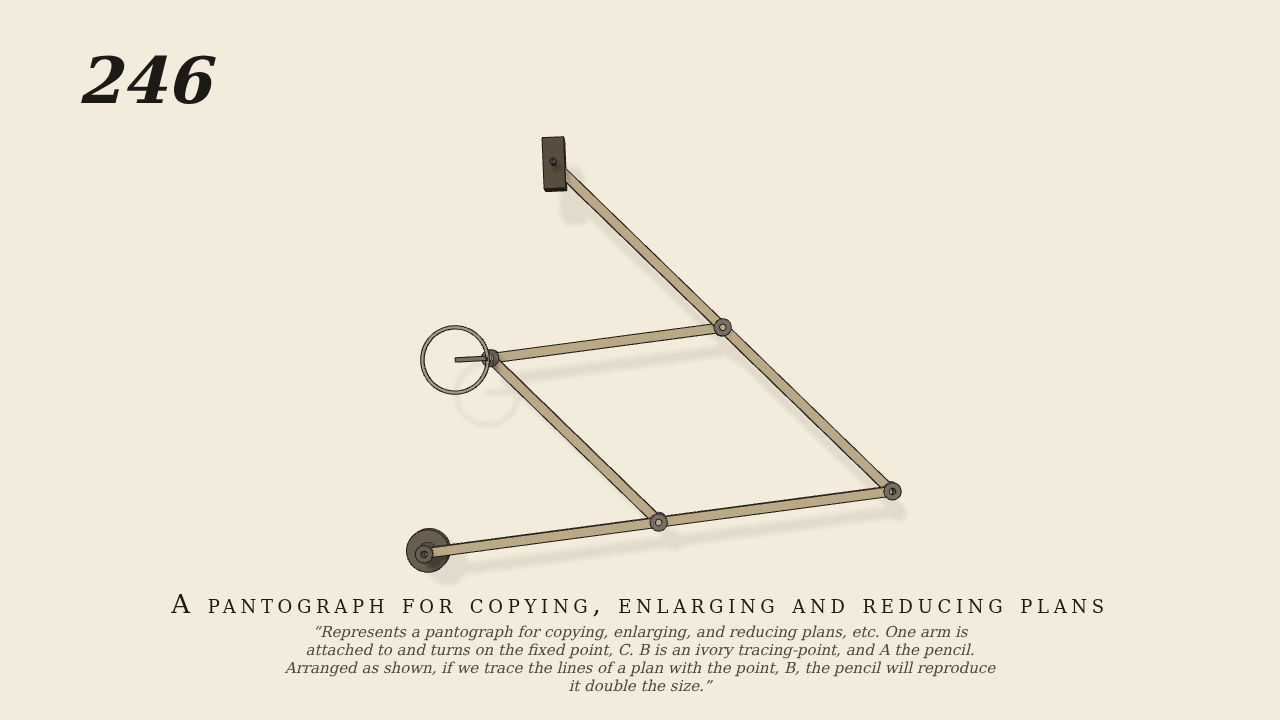
A pantograph for copying, enlarging, and reducing plans, etc
Represents a pantograph for copying, enlarging, and reducing plans, etc. One arm is attached to and turns on the fixed point, C. B is an ivory tracing-point, and A the pencil. Arranged as shown, if we trace the lines of a plan with the point, B, the pencil will reproduce it double the size. By shifting the slide attached to the fixed point, C, and the slide carrying the pencil along their respective arms, the proportion to which the plan is traced will be varied.
Only the input is driven; every other part of this model moves by physics (MuJoCo), and its ratios are measured. Run it live, change its parameters, or switch the friction off to see the output stop.
- Modelled as
- Arm CA (36 long) turns on the fixed point C. The short arm from its middle (B side, 18) and the arm from C's arm make a parallelogram with arm A: C at (0,0), the tracing point B at (0,18), the pencil A at (0,36), joints at (20,9) and (20,27), the elbow at (40,18). A template crank of radius 3 about a point 3 to the right of B guides B round a circle at 12 rev/min (the one driven joint). That is the hand tracing a plan. Plan view, no gravity. Passive x and z readout carriages are pinned at B and at A.
- Measured
- The pencil copies the point exactly double: pencil x against B x has slope 2.0000, and pencil z against B z has slope 2.0000, both with r² 1.0000 over the run. B's 6 cm circle becomes a 12 cm circle at A. The crank turns at 11.99 rev/min.
- Notes
- Brown's slides for other ratios are left fixed at the 2:1 setting he describes. The template crank stands in for the hand tracing a plan. All joints are pins and hinges; nothing touches.
Film (MP4) · Still (PNG) · Spec (YAML) · Model (MJCF)