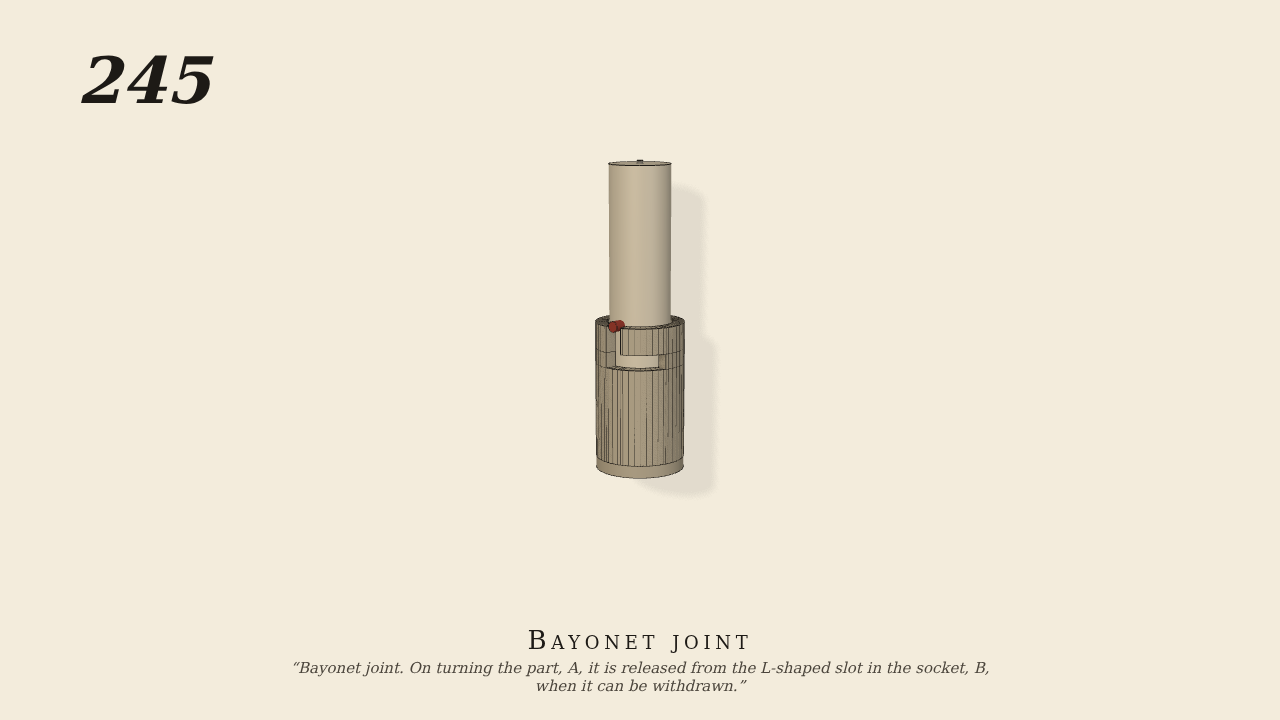
Bayonet joint
Bayonet joint. On turning the part, A, it is released from the L-shaped slot in the socket, B, when it can be withdrawn.
Only the input is driven; every other part of this model moves by physics (MuJoCo), and its ratios are measured. Run it live, change its parameters, or switch the friction off to see the output stop.
- Modelled as
- The socket B stands fixed: a bore of 2.15 inside a wall 2.9 outside, built of convex wall blocks with the L-shaped slot left out. The slot has a 60° cross leg at the pin's height, 1.0 wide, and an upright leg from it to the mouth. The part A (radius 2) sits in the bore with its pin (radius 0.35) at the far end of the cross leg. The hand pulls A steadily outward: a soft spring on A's guide gives about 8 N net of its weight, against damping in the hand's slide, so A comes out at a walking pace. The hand also turns A by a slow positioned swing (1.07 rad out and back at 0.1 Hz), the one driven joint. Pin on slot is real contact (friction 0.2); nothing else holds A in the socket.
- Measured
- While the pin is in the cross leg, the slot's upper edge holds A in against the pull: it stays 0.15 cm out from 0.3 to 1.1 s. When the turn brings the pin under the upright leg (about 1.0 rad, at about 1.8 s), A slides out steadily, about 3 cm a second, and reaches its 8 cm stop at 4.7 s. It is 6.9 cm out by 4.2 s and stays out. The rest of the swing turns it clear above the socket. The deepest contact is 0.12 mm.
- Notes
- Brown gives no sizes. The wall is cut into 7.5° blocks, with extra cuts at the slot's edges, so the slot's sides are exact. The pull is a constant-ish spring, the hand drawing on A, and is not a second drive: nothing moves A outward until the pin is free. The turn and the damped pull are slow so that the video shows the release and the withdrawal continuously.
Film (MP4) · Still (PNG) · Spec (YAML) · Model (MJCF)